The mental health App Store battleground has changed. It is now about relevance.
If you still think mental health is one big, permanently rising wave of App Store demand, APPlyzer offers a useful reality check.
On US iPhone, several core terms are softer than they were two years ago. Paid competition, on the other hand, is still very much awake. Custom Product Pages are, too.
That combination matters. It suggests this is no longer a category where marketers can rely on broad demand to do the hard work for them. It is a category where message match, intent segmentation, and smart search coverage matter a lot more than lazy reach.
Data note: App Store demand, ASA snapshots, and CPP detections are from APPlyzer (US iPhone). Public context sources are WHO, NIMH, and Apple.
First, separate underlying need from App Store demand
The underlying need is real. Public health data makes that pretty clear.
The World Health Organization reported that in the first year of the COVID-19 pandemic, global prevalence of anxiety and depression increased by 25%. In the US, the National Institute of Mental Health estimates that 59.3 million adults, or 23.1% of US adults, lived with a mental illness in 2022.
That does not mean those numbers translate neatly into app installs. They do not. What they do tell us is that mental health is not a niche theme people only visit when the calendar says it is time for a wellness reset. The need is broad, persistent, and mainstream.
APPlyzer shows softer demand on several core terms
Across the APPlyzer keyword histories with full start and end points from May 2024 to April 2026, several of the biggest mental health terms moved down in terms of daily impressions.
mental health: 2,967 to 2,052
meditation: 2,790 to 1,929
anxiety: 1,254 to 816
mindfulness: 981 to 767
calm: 3,569 to 2,790
headspace: 2,790 to 2,790
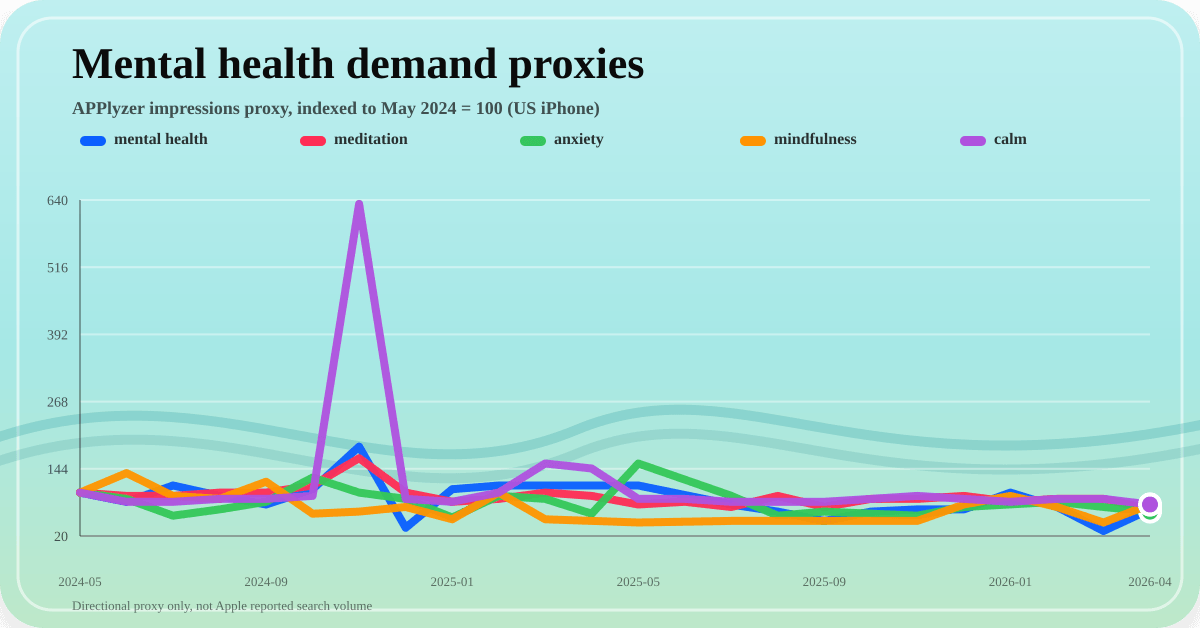
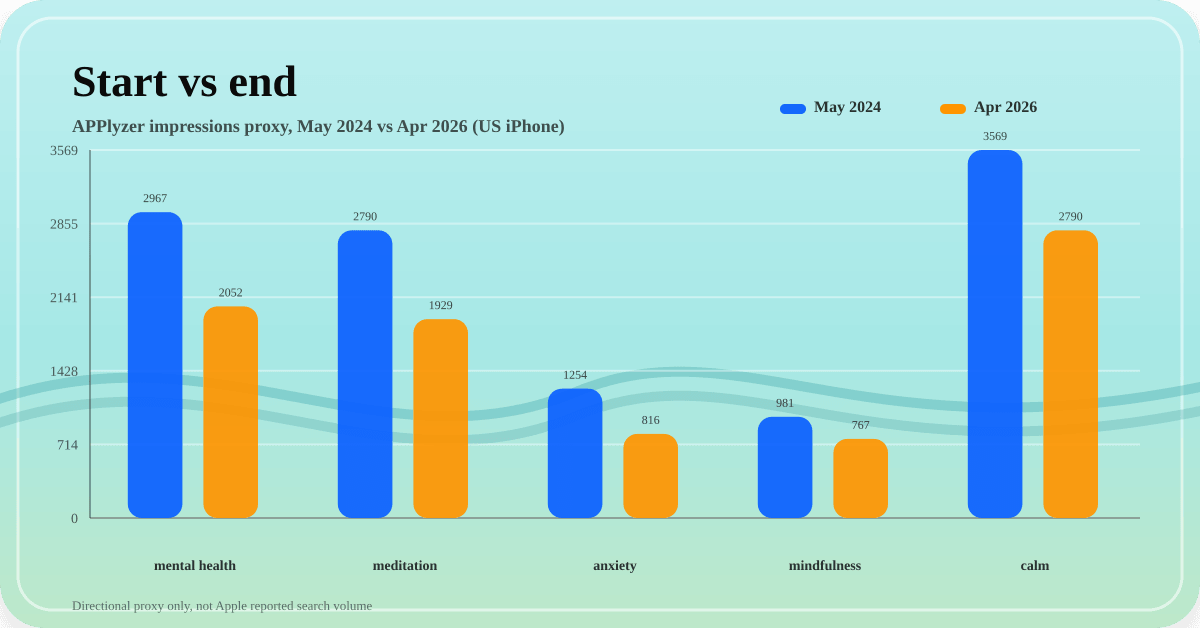
So no, the category has not disappeared. But broad keyword demand is not charging upward across the board either. That is usually the point where strategy gets more interesting.
When demand is racing up, average execution can still look clever. When demand softens, average execution gets expensive very quickly.
The app cohort is not behaving like a fresh gold rush either
APPlyzer's US iPhone download estimation history tells a similar story across the tracked app set.
In the 11-month window analysed, five of the six apps with full start and end points declined:
Calm: down 24.8%
BetterHelp: down 8.1%
Talkspace: down 1.5%
Balance: down 25.2%
Finch: down 31.5%
Headspace: up 4.5%
That is not a neat winner takes all pattern. It is also not a sign of a category in free fall. What it does look like is a more mature market, where growth is uneven and efficiency matters more than hype.
Search is still crowded, which is exactly why paid visibility still matters
If softer demand sounds like easier competition, APPlyzer says not so fast.
Its Apple Search Ads snapshots showed 5 visible ads on each of the nine tracked keywords in this analysis, including mental health, therapy, mindfulness, meditation, anxiety, depression, calm, and headspace.
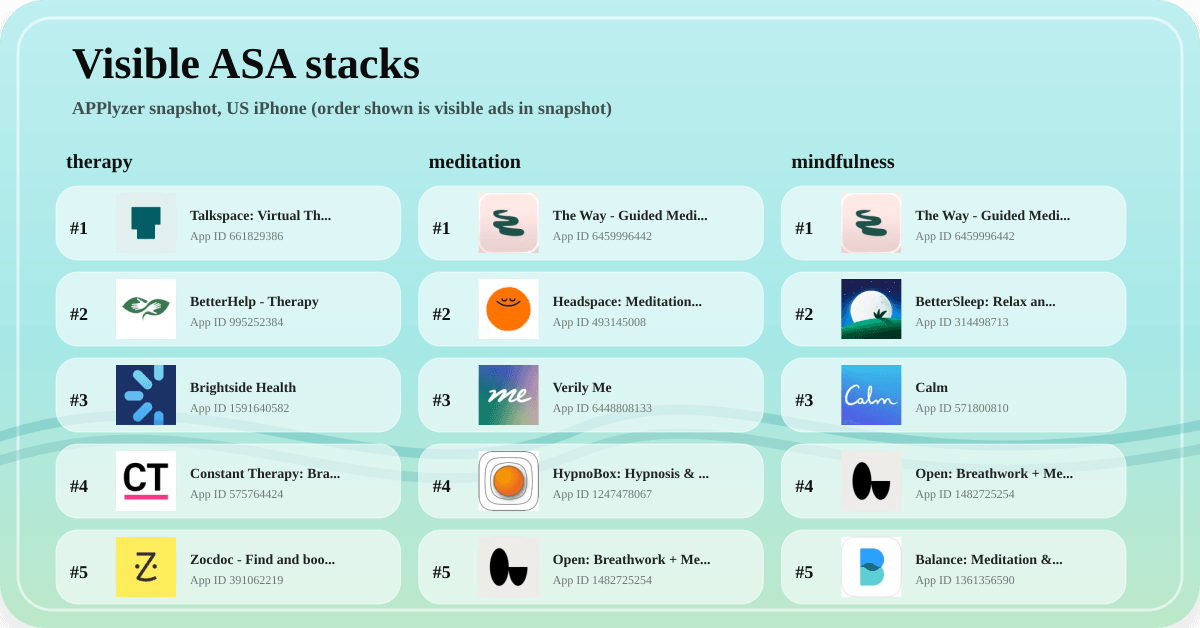
APPlyzer also picked up repeat advertisers across multiple keywords. Brightside Health appeared on 5 tracked keywords. Talkspace and BetterHelp appeared on 4 each. Ahead and Balance appeared on 3 each.
That is a useful reminder that the search results page is not just an ASO problem. It is a paid visibility problem too.
Apple's own platform data explains why marketers keep showing up there:
Over 850 million people visit the App Store every week
70% of App Store visitors use search to discover apps
Almost 65% of downloads happen directly after a search
Ads at the top of search results deliver an average conversion rate of over 60%
Custom Product Pages are where intent starts paying rent
APPlyzer detected apps with Custom Product Pages across multiple mental health keyword clusters:
mindfulness: 9 apps with CPPs detected
anxiety: 8
depression: 6
meditation: 5
mental health: 4
Apple gives the performance context. Developers see an average 2.5 percentage point increase when referring users to a Custom Product Page, compared with a 1.6% average conversion rate on default product pages. Apple also allows up to 70 additional Custom Product Pages.
Someone searching therapy is not asking for the same thing as someone searching meditation. Someone searching anxiety probably is not in the same mindset as someone searching a brand term. Someone searching mindfulness may be looking for habit support, not clinical reassurance.
A much better setup is to route intent properly:
Anxiety and stress terms to pages that lead with reassurance, trust, and immediate support
Therapy and counseling terms to pages that foreground privacy, support model, and credibility
Meditation and mindfulness terms to pages that show routine, habit, and content depth
Brand terms to pages that sharpen differentiation and reduce hesitation
The takeaway
Mental health is still a serious App Store category. The need is broad. The intent is real. The competition has not wandered off.
But the easy growth version of the story looks less convincing when you line up APPlyzer demand proxies, APPlyzer ad snapshots, and APPlyzer CPP detection side by side. This looks much more like a mature efficiency game.
The teams most likely to win are the ones that track keyword demand proxies with proper nuance, show up in search where intent is commercially meaningful, and use Custom Product Pages to match that intent properly after the tap.
So yes, there is still opportunity here. You just do not get to be vague anymore.
—————
If you manage an app in the Health and Wellbeing space and would like to know how to stand out in an increasingly challenging market, please reach out to us today as we’d love to show you how to get there :-)