
A data-led look at AI App Visibility, intent scores, prompt visibility and category rankings across top iOS apps in Games, Health & Fitness and Finance.
AI App Visibility is quickly becoming one of the more talked-about topics in app marketing. The logic is easy to understand: if users start asking ChatGPT, Gemini, Claude, Perplexity, or other AI systems which apps to download, then apps that are recommended by those systems could gain a new discovery advantage.
But does better AI visibility actually deliver App Store success?
Or is AI App Visibility simply reflecting what is already true elsewhere — that the strongest apps tend to have better metadata, stronger brands, broader web presence, better ratings, stronger category authority, and better App Store visibility already?
To explore this, we used the APPlyzer AI Visibility Index to analyse 60 iOS apps in the US App Store.
The study included:
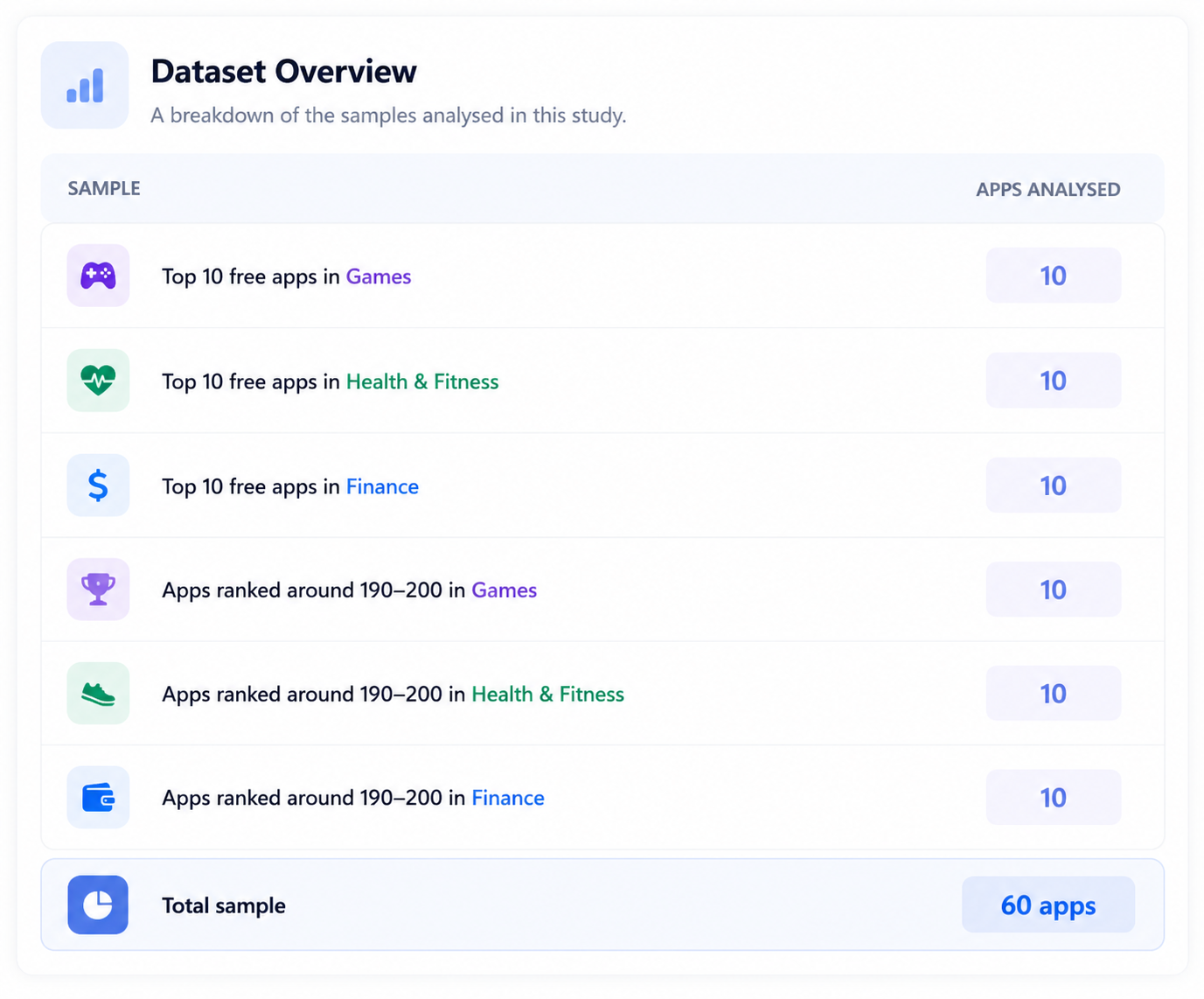
For simplicity and clarity, the APPlyzer AI Visibility Index used for this article used GPT 5.5 as the LLM scoring model.
What is AI App Visibility?
AI App Visibility measures whether an app is likely to be recommended when a user asks an AI system for app suggestions.
For example:
“What is the best app for tracking calories?”
“Which app should I use to send money?”
“What are the best iPhone puzzle games?”
“Which mobile app is best for budgeting?”
In this article, AI App Visibility is measured using the APPlyzer AI Visibility Index, which considers signals such as:
app metadata clarity
category relevance
keyword footprint
ratings
brand and prompt fit
intent coverage
prompt-level consistency
likelihood of being recommended by GPT 5.5 for relevant app-discovery prompts
This is not the same as App Store ranking.
AI App Visibility is a discovery signal. It is not a replacement for App Store Optimization, paid acquisition, brand demand, web SEO, influencer marketing, or conversion-rate optimization.
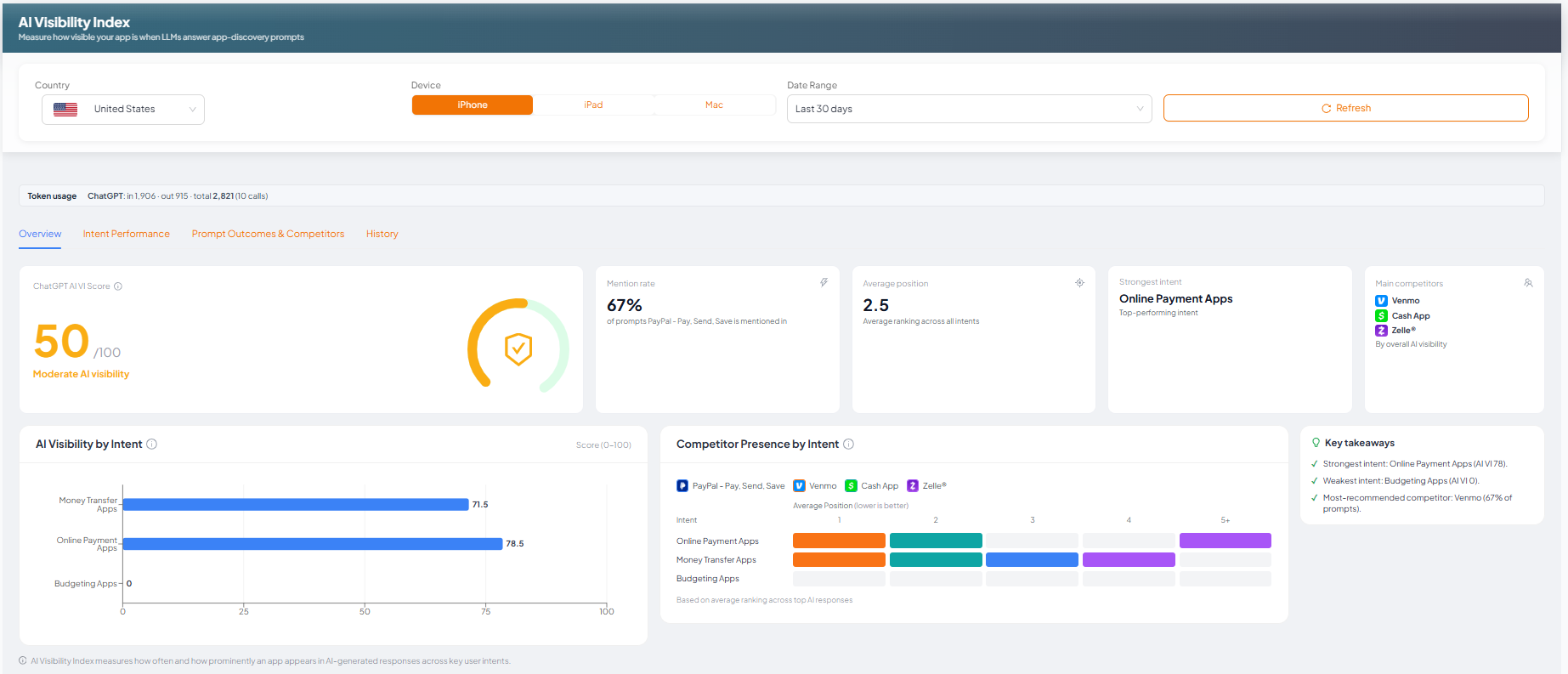
APPlyzer’s App AI Visibility Index Dashboard
Study design: 30 app leaders plus 30 lower-ranked sanity-check apps
The analysis was deliberately split into two parts.
Primary sample: top-10 apps
We reviewed the top 10 free iOS US apps in each of:
Games
Health & Fitness
Finance
This created a 30-app leader sample for comparing:
AI VI score
intent score
prompt score
keyword footprint
current category rank
Sanity-check sample: apps ranked around 190–200
We then reviewed 10 lower-ranked apps from around positions 190–200 in each of the same categories.
This added another 30 apps and helped answer a critical question:
Is AI App Visibility genuinely measuring something distinct, or is GPT simply rewarding apps that already rank highly in the App Store?
That distinction matters.
If AI systems only recommend apps that already rank highly, AI visibility is mostly a mirror of current store success. But if lower-ranked apps can still show strong AI visibility because they have strong brands, clear use cases, and strong intent ownership, then AI visibility becomes a more useful standalone diagnostic.
The headline finding: AI visibility matters, but the hype is ahead of user behaviour
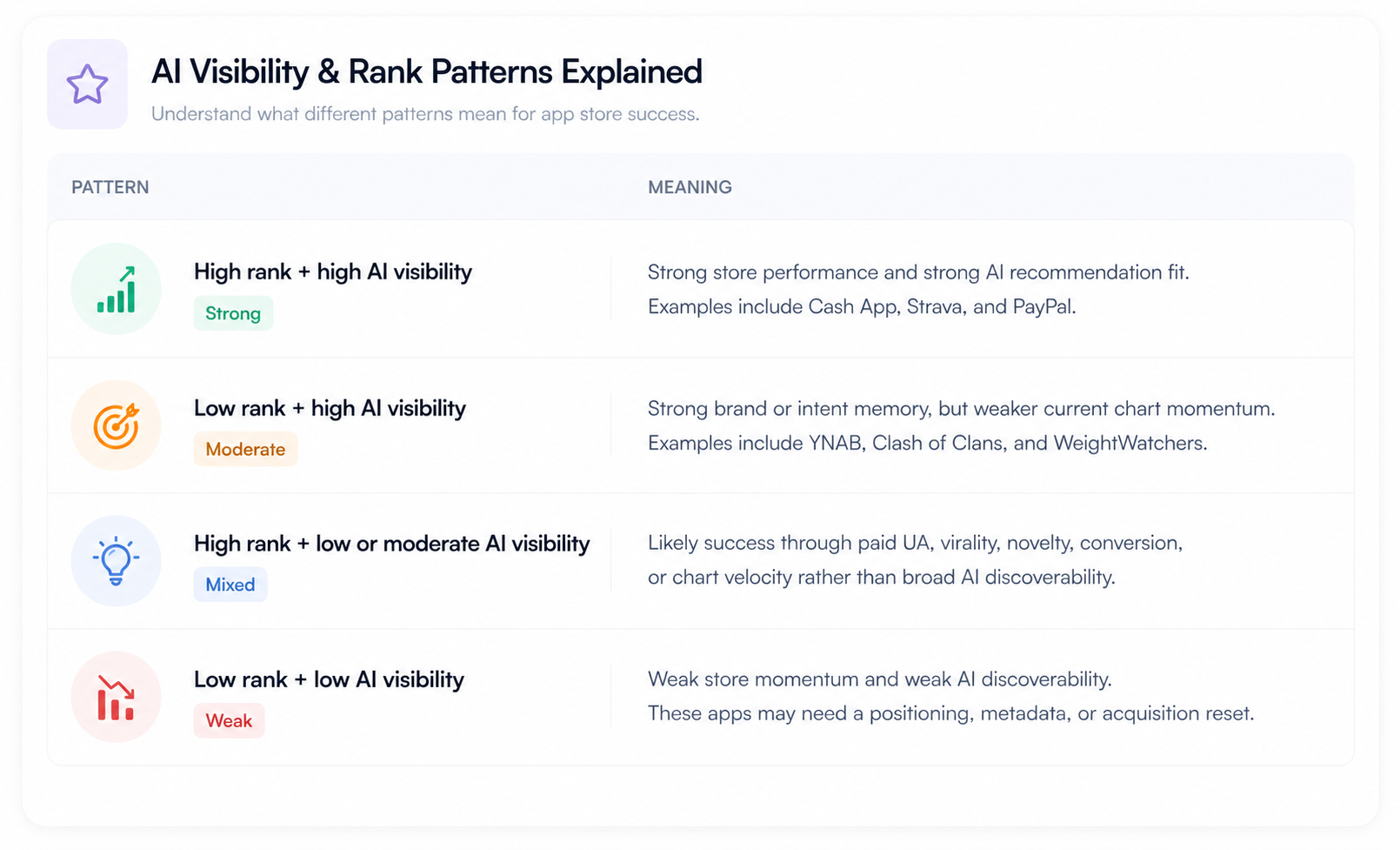
There is a correlation between AI App Visibility and App Store success, but it is not strong enough to justify the claim that AI visibility is “the new ASO”.
In the top-10 sample, the overall correlation between APPlyzer AI VI and category rank success was around 0.39.
Prompt-level consistency was similar at 0.38, while intent-level scoring was slightly weaker at 0.33.
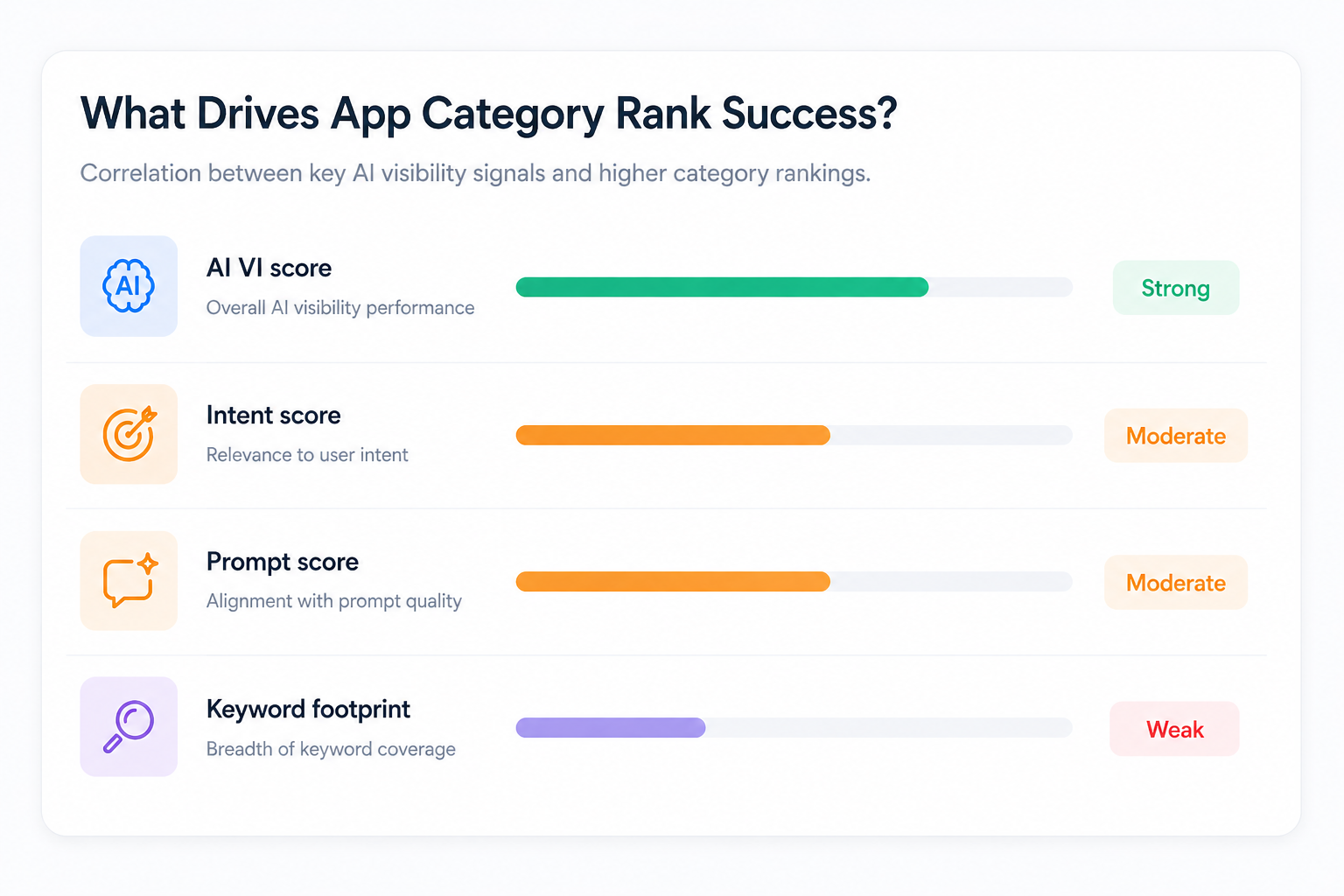
That is meaningful, but not transformational.
It suggests that apps which are easier for GPT 5.5 to understand, classify, and recommend often have strong store performance — especially in categories such as Finance and Health & Fitness.
But it does not prove that LLM recommendations are currently a bigger driver of installs than App Store search, paid acquisition, brand demand, web SEO, influencer marketing, or conversion rate.
AI App Visibility is an important diagnostic layer. It is not a silver bullet, and it is not yet more important than being visible where most users still search: the App Store.
Correlation by category
The relationship between AI App Visibility and App Store rank varied significantly by category.
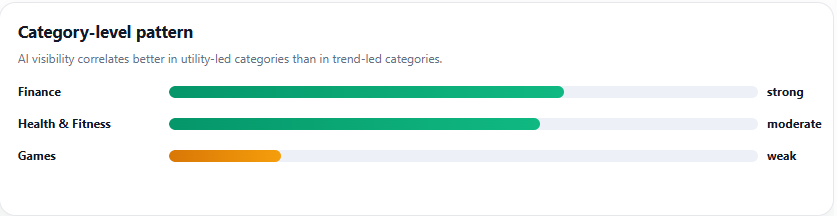
The category-level view is the most important part of the analysis.
AI visibility appears more predictive in utility-led categories, where users express clear problems and needs. Finance and Health & Fitness are good examples.
It is much less predictive in categories where chart rank can be driven by fast-moving trends, paid acquisition, creative performance, or novelty. Games is the obvious example.
Intent and prompt scores reveal more than the headline AI Visibility Index
The headline AI VI score is useful, but the prompt and intent layers are where the actionable insight lives.
Intent score
Intent score measures whether an app is visible across the needs users are likely to express.
Examples:
send money
track calories
find hiking trails
play puzzle games
learn budgeting
improve sleep
track running
monitor credit score
Prompt score
Prompt score measures whether the app is consistently surfaced when those intents are phrased in different natural-language ways.
For example, a budgeting app might be tested against prompts such as:
“What is the best app for budgeting?”
“Which iPhone app should I use to manage my spending?”
“What app helps me follow a monthly budget?”
“Which mobile apps are best for personal finance planning?”
This matters because an app can have a decent overall AI Visibility Index while still being weak for commercially important prompts.
Kalshi is a good example from the Finance sample. It had a huge keyword footprint and strong category rank, but its AI visibility was concentrated around prediction-market and sports-trading prompts. It is much less likely to surface for broad finance prompts such as:
best banking app
best budgeting app
best app to send money
best credit score app
best savings app
That makes its AI visibility deep, but not necessarily broad.
Selected app-level examples
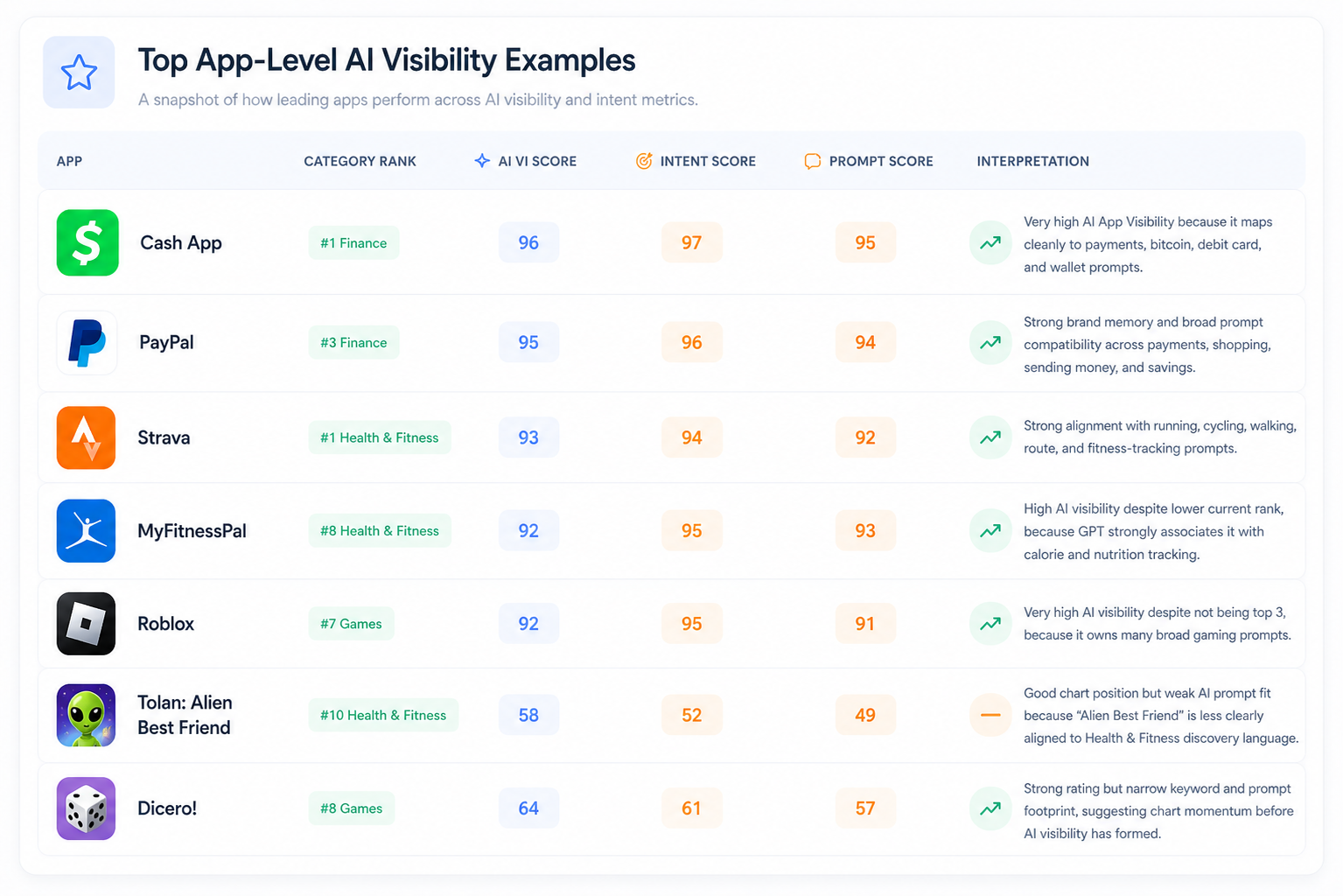
Could the correlation simply mean LLMs reward apps that already rank higher?
This is the most important caveat in the study.
If GPT 5.5 has access to signals that reflect App Store popularity, web popularity, reviews, press coverage, brand mentions, ranking pages, or general market awareness, then higher AI Visibility scores may partly reflect existing market visibility rather than causing that visibility.
The direction of causality may not be:
Better AI Visibility → better App Store rank
It may be closer to:
Better-known app → better web/store presence → stronger LLM recommendation likelihood → better AI App Visibility
That does not make AI App Visibility useless.
It simply means marketers should not treat it as an isolated ranking factor. AI visibility is more likely to be a mirror of several underlying strengths:
clear positioning
brand authority
web presence
app metadata quality
review quality
search demand
category relevance
broad keyword footprint
This is why the lower-ranked sanity-check sample matters.
Sanity check: what did we see around ranks 190–200?
To test whether AI App Visibility was simply a restatement of current App Store rank, we reviewed a lower-ranking control group around positions 190–200 in the same three categories.
If GPT 5.5 were simply rewarding apps that rank higher in the App Store, then apps near #200 should consistently show weak AI visibility.
But that is not what the sanity check suggested.
Some lower-ranked apps are indeed weak from an AI App Visibility perspective. They may have narrow keyword footprints, generic metadata, limited brand recall, or unclear category positioning.
But others still appear highly promptable because they have strong brands or own very clear user intents (as below):
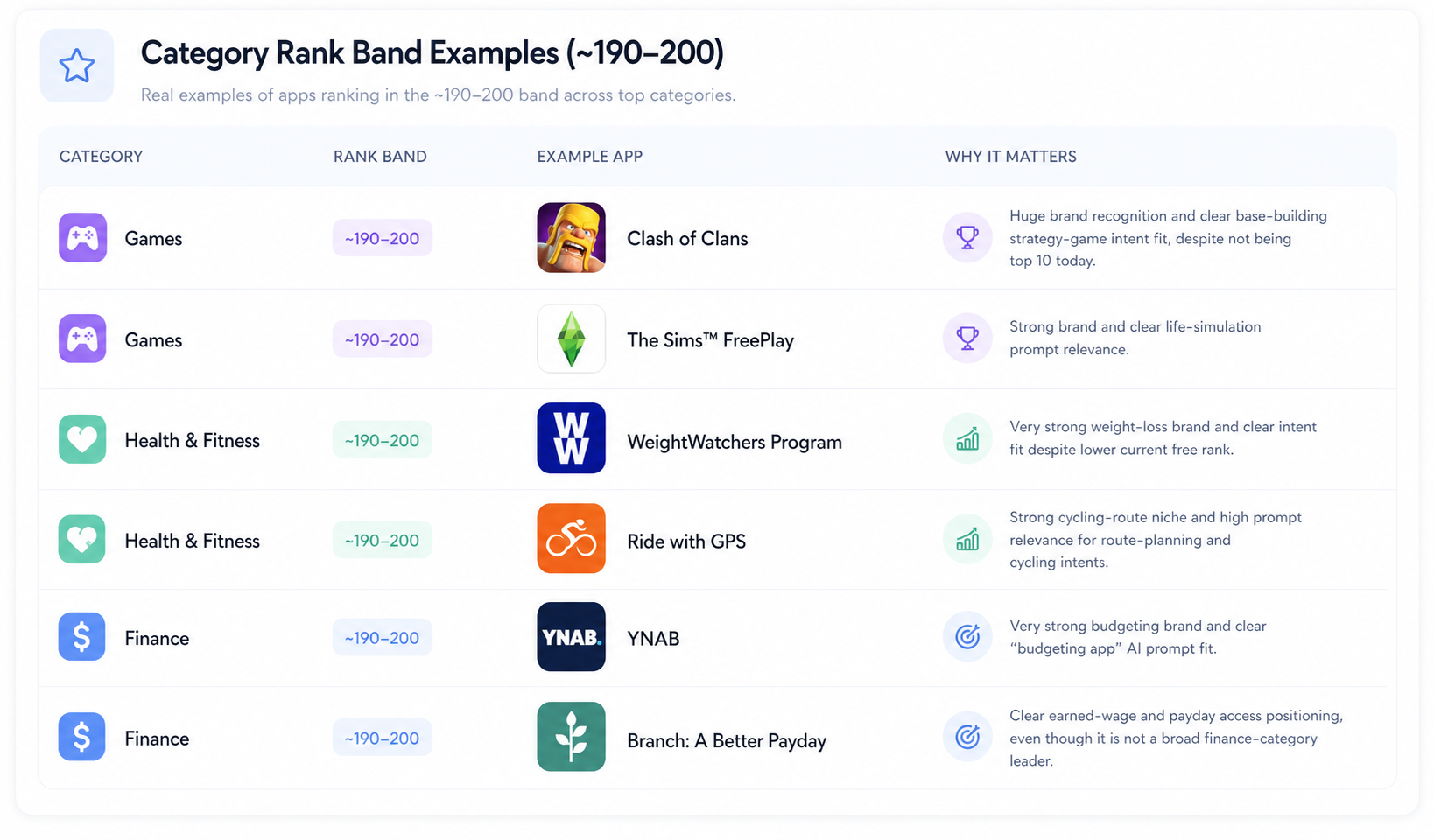
The sanity-check takeaway is important:
AI App Visibility is not simply a proxy for current category rank. Some lower-ranked apps still have strong likely AI visibility because they own clear user intents or have strong brand recognition.
That supports a more cautious conclusion: AI visibility is useful, but it does not prove causation and it does not replace App Store ranking, ASO, SEO, paid acquisition, or brand demand.
Why Games pours cold water on AI visibility hype
The Games category is the clearest reason to be careful with AI visibility claims.
In Games, the relationship between AI VI and rank was weak. Prompt scores correlated better than intent scores, but still only modestly.
That is because many users do not discover mobile games by asking GPT 5.5:
“Which puzzle game should I download?”
Instead, they discover games through:
App Store charts
paid ads
short-form video creatives
playable ads
friend recommendations
featuring
brand IP
viral loops
trend momentum
That does not mean AI visibility is irrelevant for Games.
Roblox is a strong counterexample. It has powerful AI App Visibility because it is embedded in broad prompts such as:
best multiplayer games
games for kids
social gaming apps
games where you can create worlds
metaverse games
avatar games
But many chart-climbing puzzle games can rank well before they have any meaningful AI discovery footprint.
This is why Games is a useful category for pouring cold water on simplistic AI visibility claims.
AI App Visibility versus App Store search
The biggest mistake in the AI visibility conversation is assuming that LLM visibility immediately becomes more important than App Store visibility.
It does not.
For many categories, users are still far more likely to search inside the App Store than ask an LLM which app to download.
A user looking for a shopping app, coupon app, food delivery app, weather app, or casual game may still go directly to the store, search a keyword, tap an ad, follow a brand link, or install from a chart.
AI App Visibility should therefore be treated more like web visibility:
important, measurable, and strategically useful — but not automatically the main source of growth.
If users increasingly ask AI systems what apps to download, AI visibility will matter more. But today, it should sit beside:
ASO
SEO
paid acquisition
brand marketing
creative testing
conversion optimisation
review management
category ranking strategy
It should not replace them.
What separates high AI-visibility apps from low AI-visibility apps?
Across the analysis, high AI-visibility apps tended to share six characteristics.
1. Clear metadata
Apps with titles and subtitles that explain the use case are easier for GPT 5.5 to map to prompts.
Examples:
MyFitnessPal: Calorie Counter
Strava: Run, Bike, Walk
Flo Cycle & Period Tracker
PayPal - Pay, Send, Save
2. Intent ownership
Strong apps own natural user needs.
Examples:
Cash App owns “send money”
MyFitnessPal owns “track calories”
Strava owns “track runs”
YNAB owns “budgeting”
AllTrails owns “find hiking trails”
3. Brand and web presence
LLMs are more likely to remember and recommend apps with broad cultural, web, and category presence.
This is why apps like Roblox, PayPal, WeightWatchers, and Clash of Clans can retain strong likely AI visibility even when they are not currently top 3 in their category chart.
4. Keyword footprint
A large keyword footprint does not guarantee AI visibility, but it often reflects broad user-intent coverage.
Apps with broad keyword footprints tend to be easier to associate with many user needs.
5. Trust signals
Ratings, reviews, and known brands can influence recommendation confidence.
Almost every top app in the sample had a strong rating, so rating alone did not explain the ranking spread. But a weak rating would likely hurt AI recommendation confidence.
6. Category-language fit
Apps that describe themselves in the language users actually ask for tend to be more promptable.
This is why “Calorie Counter”, “Run, Bike, Walk”, and “Pay, Send, Save” are strong AI visibility signals.
By contrast, a title like “Alien Best Friend” may be emotionally compelling, but it is less clearly aligned with Health & Fitness discovery language.
Final answer: does better AI visibility deliver App Store success?
Sometimes.
But not by itself.
In Finance, stronger AI visibility lines up well with category success because the leading apps are famous, trusted, clearly positioned, and easy for LLM’s to recommend.
In Health & Fitness, the relationship is also meaningful, especially for apps that map clearly to common user problems.
In Games, the link is much weaker because category rank is often driven by momentum, acquisition, and creative performance rather than AI recommendation strength.
The lower-rank control group makes the conclusion more credible.
Apps such as YNAB, WeightWatchers, Ride with GPS, Clash of Clans, and The Sims FreePlay show that lower current rank does not necessarily mean weak AI visibility. Strong brand memory and clear intent ownership can persist even when a current category chart position is weaker.
The practical conclusion is that AI App Visibility should become part of every serious ASO and growth dashboard.
But it should be used as a diagnostic and benchmarking layer, not as a replacement for the fundamentals.
App Store rank tells you what is winning in the store today. AI App Visibility tells you which apps are likely to be recommended when users ask AI what to download. The winners of the next discovery cycle will be strong in both places.
—————
If you would like to discuss how CMA can help improve your LLM footprint, please reach out to us today as we’d love to show you how to build a scalable and profitable multi-channel app growth strategy!
Methodology note
APPlyzer data was pulled for 60 iOS US apps on April 27, 2026: the top 10 free apps in Games, Health & Fitness and Finance, plus 10 apps from around positions 190–200 in each of the same categories.
The APPlyzer AI Visibility Index used for this article was a simplified GPT 5.5-only model using APPlyzer metadata, ratings, keyword footprint, category rank, promptability, and intent fit.