
The UK Retail App Search Wars: AliExpress owns the front door, and Very seems to be everywhere
Search for “retail app” in the App Store and you might expect to find the centre of the UK retail universe.
You won’t.
You’ll mostly find that hardly anyone searches like that, because normal people don’t wake up thinking, “I must download a retail application today.” They search for what they actually want. Shop. Shopping. Online shopping. Clothes shopping. Sneakers. Deals. Grocery delivery. Furniture. Perfume. Used clothes.
In other words, the UK retail app market on Apple Ads is not one big fight. It is a messy collection of smaller scraps in different corners of the App Store car park.
So we looked at a broad set of generic, non-brand UK retail search terms using APPlyzer data, covering daily search demand, search scores and the full Apple Ads auction results (positions 1-5).
And the headline is pretty clear:
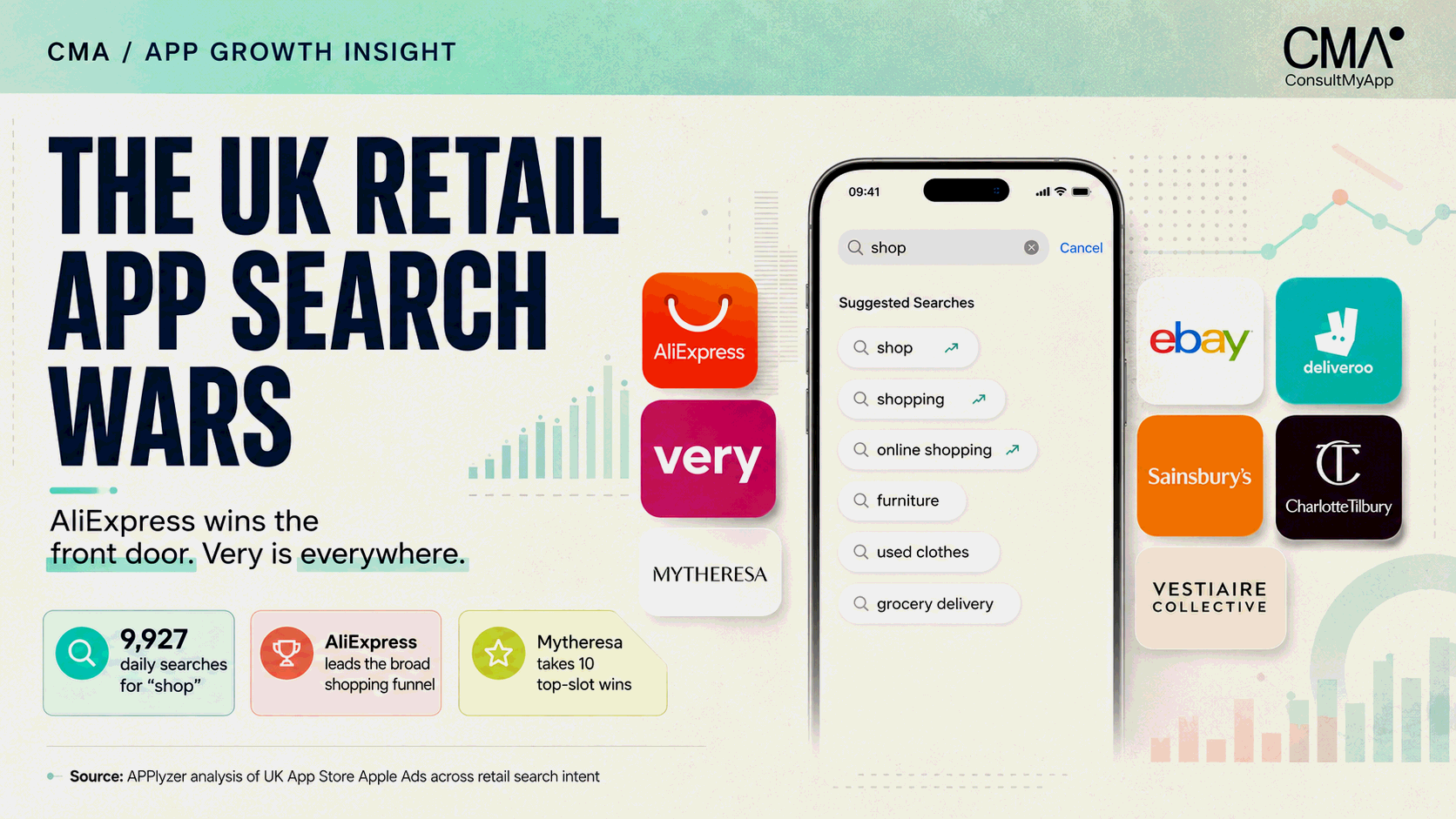
AliExpress owns the front door. Very is basically everywhere. And Mytheresa has turned up to more fights than anyone expected.
First problem: “retail app” is a rubbish keyword
Let’s get this one out of the way.
The keyword “retail app” has just 33 estimated daily searches in the UK App Store.
Meanwhile, “shop” has 9,927.
That is not a small gap. That is a “you’ve brought a tote bag to a warehouse move” gap.
So if you are building your Apple Ads strategy around internal category language like “retail app”, you are probably missing where the actual demand is.
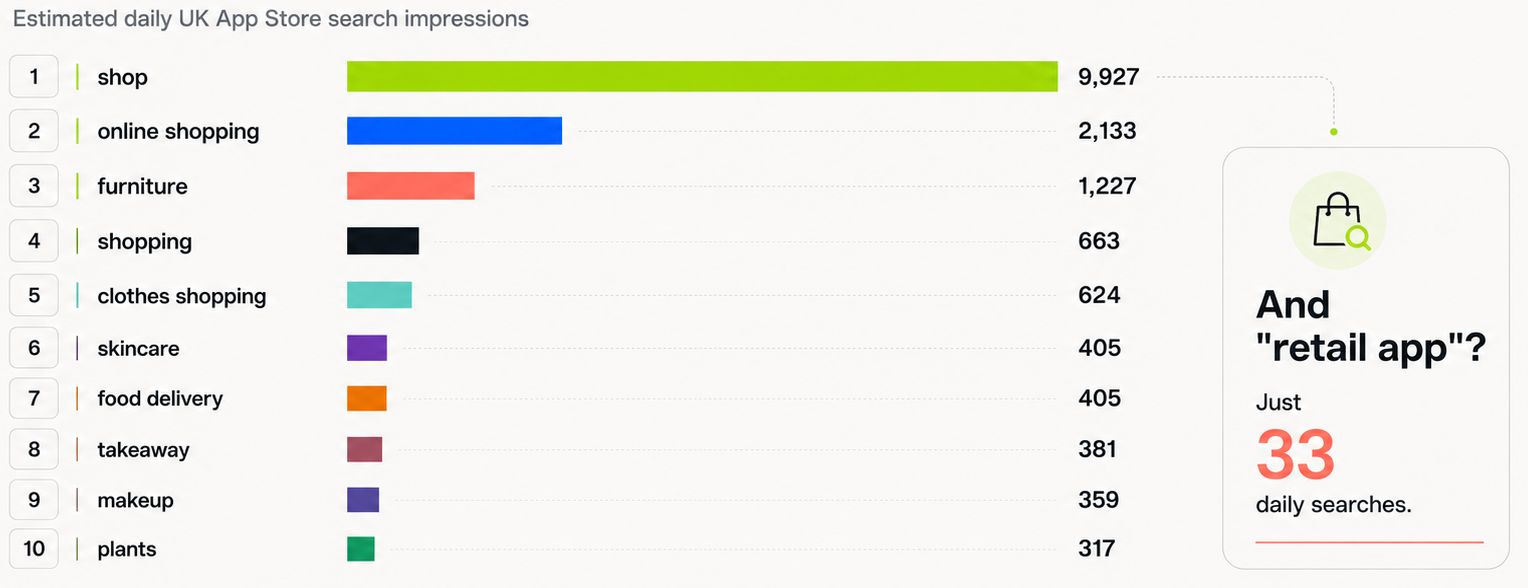
The real market sits around shopper intent:
shop
shopping
online shopping
deals
clothes shopping
grocery delivery
furniture
used clothes
perfume
trainers/sneakers
This matters because Apple Ads is not about what your CRM team calls the customer journey. It is about what people type when they are bored on the sofa and suddenly decide they need trainers, foundation, a new lamp and possibly a slow cooker.
Broad shopping: AliExpress is not messing about
On the big broad shopping terms, AliExpress is the clearest winner.
It takes the top Apple Ads slot for:
shop
shopping
shopping app
online shopping
buy online
That is a very strong position. These are not tiny long-tail queries. These are the terms sitting right at the top of the retail app discovery funnel.
To put it simply: if a UK user opens the App Store and searches something broad and shopping-related, there is a very good chance AliExpress is standing there waving.
Temu, SHEIN and Very all appear in the mix, but AliExpress is the one consistently taking the best seat at the table.
Or, less politely, it has nicked the table.
Very is the quiet monster in the room
Very is not always number one. But that almost misses the point.
Very appears across a ridiculous spread of retail intent:
broad shopping
fashion
footwear
furniture
beauty-adjacent searches
resale-adjacent searches
generic retail terms
That kind of coverage is valuable because real shoppers do not behave neatly.
Someone might search “online shopping” today, “clothes shopping” tomorrow, “furniture” next week and “women shoes” after payday. Very keeps appearing across those moments.
So while AliExpress wins the front door, Very is wandering around the entire building checking every room.
That makes it one of the most interesting advertisers in the study. Not because it dominates one cluster, but because it keeps showing up across lots of them.
Mytheresa is the surprise troublemaker
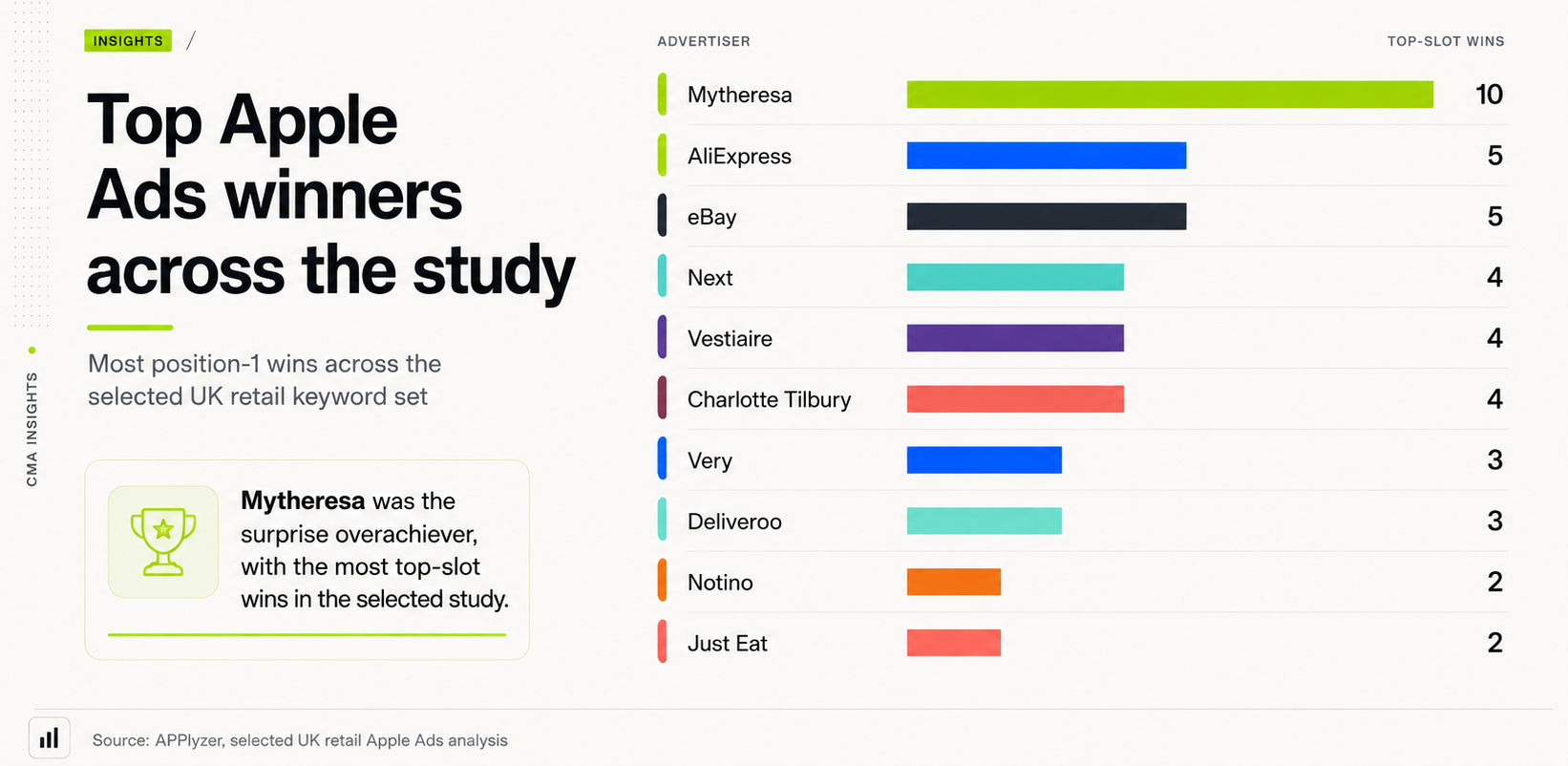
Mytheresa was the biggest “hang on a minute” in the data.
You would expect it to be strong on luxury terms. Fine. That makes sense.
But it is also showing up aggressively across broader fashion and discount-led searches, including:
buy clothes
men fashion
summer dresses
discount shopping
sale shopping
luxury fashion
luxury shopping
designer bags
designer shoes
This is not a luxury brand politely waiting for affluent users to search “designer fashion” while holding a glass of champagne.
It is much more active than that.
Across the studied set, Mytheresa took 10 top-slot wins, which made it the most frequent position-one winner overall. That is a proper finding.
The brand may sit in luxury, but its Apple Ads strategy looks far more expansionist.
Fashion is fragmented, because of course it is
Fashion does not have one clean winner. It is split by intent.
Very wins “clothes shopping” and “fashion shopping”.
Next wins “womens clothes” and “women fashion”.
New Look wins “mens clothes”.
REVOLVE wins “dresses”.
Zalando wins “jeans”.
Mytheresa wins a surprising amount around broader fashion and sale-led searches.
So the fashion story is not “one app dominates everything”. It is more like a school lunch queue where everyone is fighting for a different pudding.
The practical point: fashion Apple Ads need proper keyword clustering. Womenswear, menswear, dresses, jeans, luxury, discount and generic “clothes shopping” are not the same battle.
Treating them as one campaign bucket would be lazy. And probably expensive.
Resale is now a serious Apple Ads battleground
The resale and marketplace terms are some of the cleanest in the study.
Vestiaire wins:
used clothes
vintage clothes
second hand clothes
eBay wins:
marketplace
preloved
deals
alias wins:
sell clothes
Shopify wins:
sell online
Whatnot wins:
auction
That is a really neat split. Different resale players are winning different flavours of intent.
This tells us resale is no longer some cute little side hustle category hanging around the edge of retail. It is a proper paid acquisition market with clear tactical positioning.
People are not just shopping second-hand. They are searching for it directly, and the apps are fighting for those searches.
Grocery is being gatecrashed by delivery apps
Grocery is where things get particularly awkward for traditional supermarkets.
On clean grocery terms, supermarkets still do well.
Sainsbury’s wins:
grocery shopping
online groceries
Waitrose also appears in the top results for grocery-related terms.
So far, so normal.
But once you move into broader food and delivery intent, the delivery apps pile in.
Deliveroo wins or appears strongly across grocery and food-shopping terms. Just Eat wins “food delivery” and “takeaway”. Uber Eats is a regular runner-up.
This matters because consumers do not separate these categories as neatly as retail teams do.
To a supermarket, “weekly shop”, “food delivery”, “groceries” and “takeaway” might sit in different strategic boxes.
To a hungry person with an iPhone, it is all just: how do I get food into my house with the least effort possible?
That is a dangerous overlap for grocery brands.
Beauty is clean, until it suddenly isn’t
Beauty has two personalities.
When the query is clearly commercial, the auction makes sense.
Charlotte Tilbury wins:
beauty
skin care
cosmetics
makeup shopping
P Louise wins:
beauty shopping
Notino wins:
perfume
fragrance
Boots and The Fragrance Shop also appear in relevant places.
Lovely. Sensible. Everyone behaving themselves.
Then you look at broader terms like “makeup”, “skincare” and “hair products”, and suddenly the auction is full of face editors, scanners, AI tools, health apps and apps that look like they might tell you your skin is both dry and emotionally unavailable.
This is why volume alone is dangerous.
A keyword can look attractive because it has demand, but if the auction is full of non-retail apps, it may not be a clean retail opportunity.
Home and DIY: proceed with caution
Home is a mixed bag.
Some terms are genuinely useful:
furniture
homeware
garden furniture
beds
mattress
Very wins “furniture”. Next wins “homeware” and “garden furniture”. Wilko wins “mattress”. Dunelm appears strongly for furniture.
So there is definitely retail value here.
But then the category starts throwing banana skins everywhere.
“Sofa” gets hijacked by Sofascore and sports apps.
“DIY” is game-heavy.
“Paint” is colouring apps.
“Home decor” and “decorating” are full of AI design and home makeover games.
“Plants” is plant-care apps, not plant retailers.
“Garden centre” is basically game central.
So yes, home retail has Apple Ads potential. But only if you choose terms carefully. Otherwise you think you are bidding on home improvement and accidentally end up competing with a cartoon farm.
Electronics is weirdly weak
Electronics should be interesting. On paper, it feels like a big retail category.
In practice, the Apple Ads auction is messy.
“Tech shopping” is the best of the lot, with Argos and Very appearing, although Mytheresa somehow takes the top slot, because apparently it fancied a wander into tech.
But terms like:
laptops
phones
camera
computer
smartwatch
headphones
are mostly dominated by utilities, AI apps, camera apps, phone-number apps, fitness apps, trackers and other non-retail results.
So for electronics retailers, broad product keywords may not behave like shopping keywords in the App Store.
A person searching “camera” in the App Store is more likely looking for a camera app than a camera to buy. Obvious in hindsight. Expensive if you ignore it.
The big lesson: search intent is doing all the work
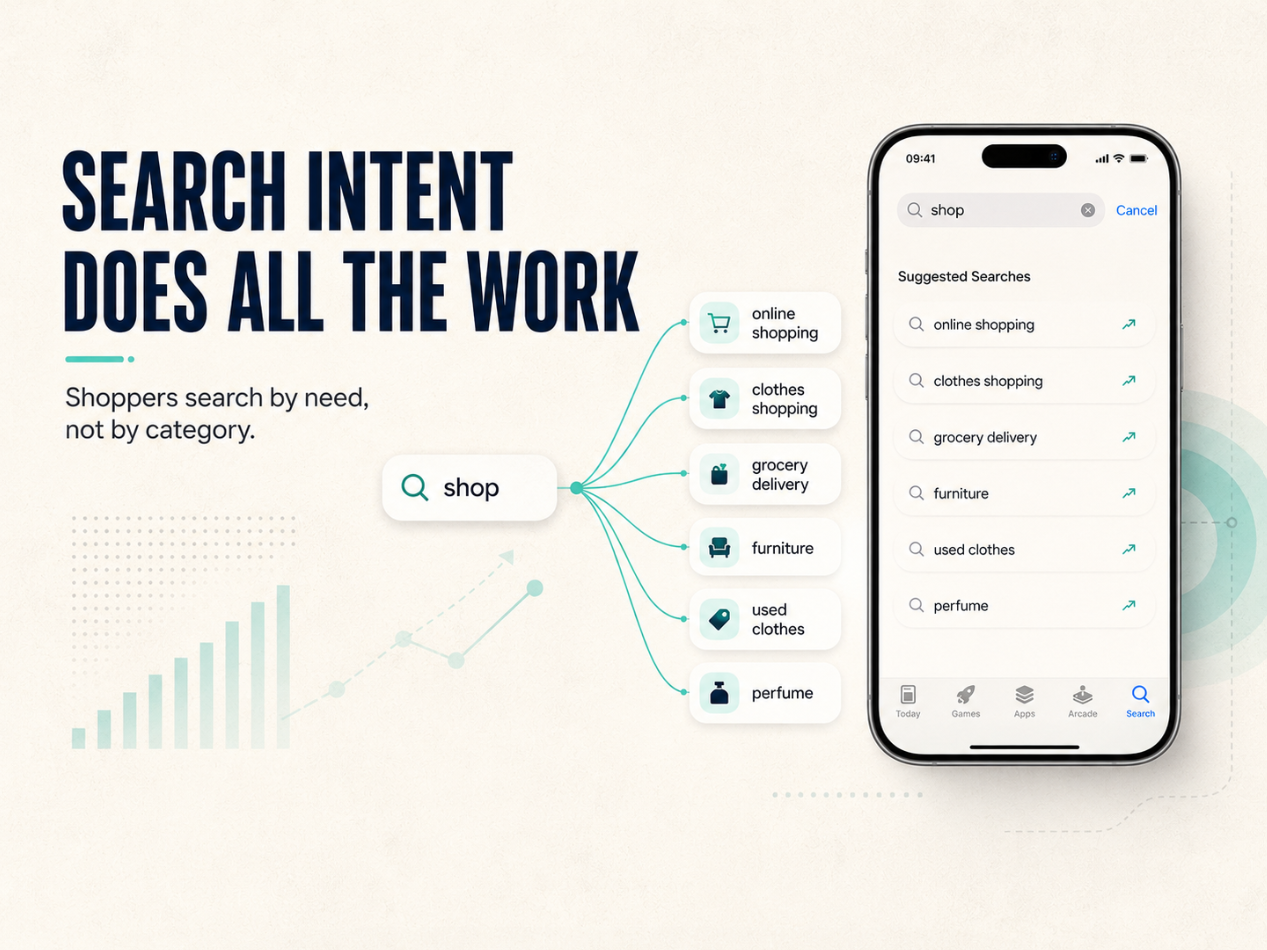
This study really comes down to one point:
Retail Apple Ads is not about categories. It is about intent.
The difference between a good keyword and a waste of budget is not always search volume. It is whether the auction actually matches retail behaviour.
Some high-volume terms are clean and valuable.
Some are full of games, scanners, utilities, AI tools and random apps that have wandered into the auction wearing a fake moustache.
So before retailers throw budget at Apple Ads, they need to ask:
Is this keyword actually retail-relevant?
Who is already buying the top slot?
Is the runner-up a serious competitor or a completely different type of app?
Does the search term match shopper intent, or just category language?
Are we bidding on what people actually type, or what we wish they typed?
Because those are very different things.
So, just who is winning?
Here is the short version.
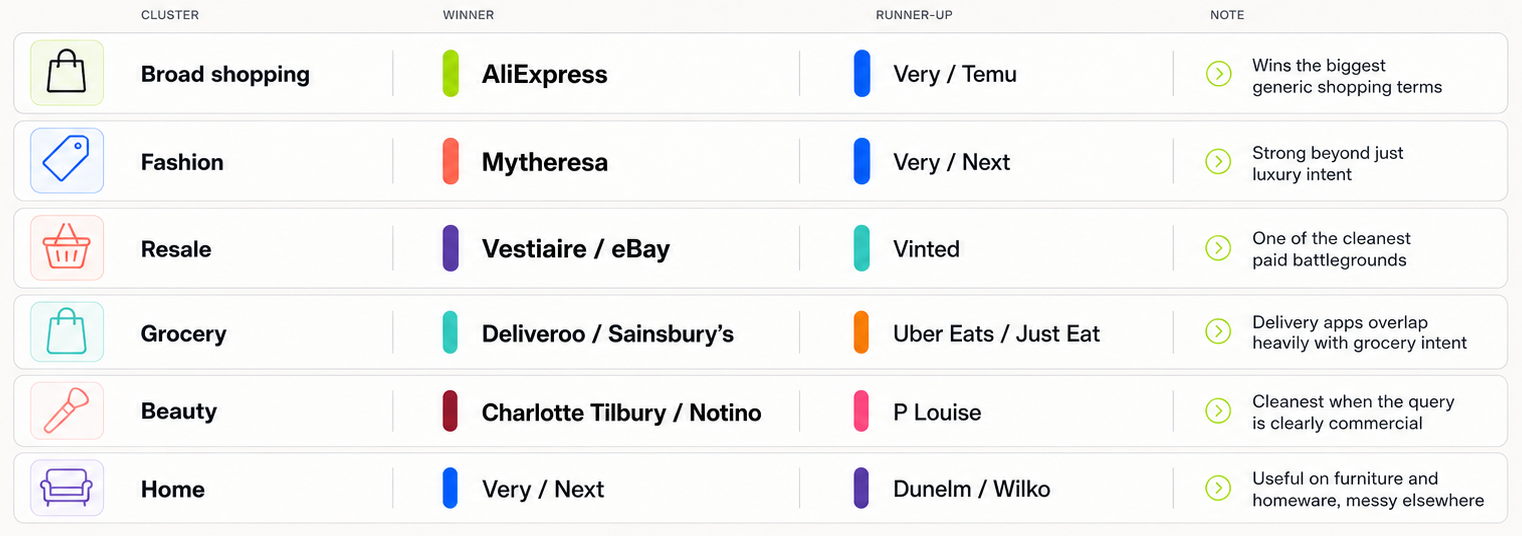
AliExpress wins the broad shopping funnel.
Very is the most persistent cross-category player.
Mytheresa is the surprise overachiever, with far more top-slot wins than its luxury positioning might suggest.
Vestiaire, eBay, Vinted, alias, Shopify and Whatnot are carving up resale and marketplace intent.
Sainsbury’s wins clean grocery terms, but Deliveroo, Just Eat and Uber Eats are all over the delivery-led searches.
Charlotte Tilbury, P Louise and Notino are strong when beauty searches are clearly commercial.
Home and electronics need careful keyword selection, because plenty of obvious-looking terms are actually full of noise.
Final thought
The UK retail App Store is not one neat marketplace.
It is a jumble of mini-markets, each with its own winners, weird edge cases and occasional “why is that app here?” moment.
The retailers that win will not just be the ones spending the most. They will be the ones that understand the search landscape before they start bidding.
Because in Apple Ads, buying traffic is easy.
Buying the right traffic is where it gets interesting.
Have a retail app and want to make it really stand out in the market? Working with some of the world’s largest global retail brands for over 10 years, we know how to make your app grow at pace. Reach out to us today and we’d love to have a conversation!