
Who’s Winning Apple Search Ads Across UK Finance Apps?
Apple Search Ads in UK Financial Services is no longer just a fight between banks.
FinTech is now a much broader App Store battleground where challenger banks, investment platforms, savings apps, credit-score providers, insurance brands, money-transfer apps, business finance tools and even some unexpected non-finance apps are competing for the same user intent.
That matters because App Store search is one of the clearest places to observe commercial intent.
A user searching “bank account”, “cash ISA”, “credit card”, “mortgage calculator”, “car insurance” or “budgeting app” is not just browsing. They are actively expressing a need. Apple Search Ads gives brands the chance to appear at the exact moment that need is being declared.
So, who is actually winning?
To answer that, we used APPlyzer to review Apple Search Ads auction visibility across 40 UK iOS App Store search terms covering banking, current accounts, savings, ISAs, mortgages, loans, credit cards, budgeting, credit scores, insurance and buy now pay later - examining which apps placed #1 - #5 in the Apple Ads auction.
The results show a market that is more fragmented, more aggressive and far more category-specific than a simple “best banking app” search would suggest.
Study design: 40 UK banking and personal finance search terms
The keyword set was designed to cover both broad banking discovery and product-specific financial intent.
The analysis included searches across:
banking and current accounts, savings and ISAs, mortgages, loans, credit cards, budgeting, money management, credit score, insurance, payday loans and buy now pay later.
For each keyword, we reviewed the top Apple Search Ads results returned in the UK iOS App Store. Where ads were returned, the first five auction positions were used to build a view of paid share of voice.
Organic App Store results were also reviewed to compare who is buying visibility against who is already ranking well organically.
The headline finding: Monzo wins paid banking visibility
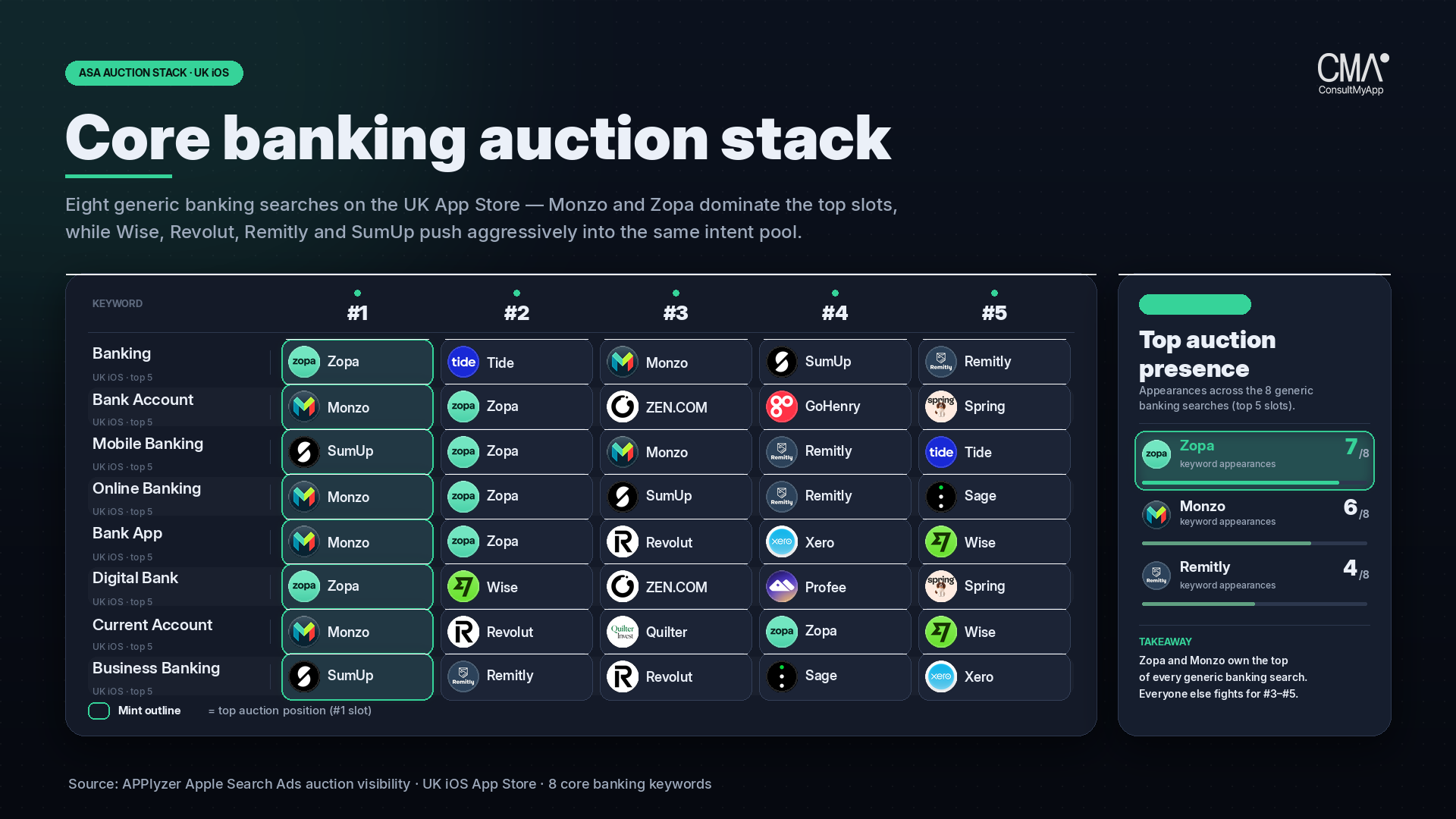
Across the full dataset, Monzo is the clearest paid banking winner.
Monzo appeared repeatedly across high-intent banking and finance searches and won position one on several commercially valuable terms, including:
bank account, online banking, bank app, current account, savings, savings account and travel credit card.
That is a strong signal.
Monzo is not only defending generic mobile banking demand. It is also using Apple Search Ads to expand into product-led searches where users may be closer to opening, switching or deepening a financial relationship.
From an app marketing perspective, this is exactly where Apple Search Ads can be most valuable. A user searching “bank account” or “savings account” has much clearer intent than a user passively browsing the Finance category.
Monzo is consistently buying the first opportunity to convert that intent.
Zopa is the strongest challenger in core banking
Zopa is the most consistent paid challenger in the core banking set.
Zopa won position one for “banking” and “digital bank” and appeared prominently across several generic banking searches. It was especially visible in the second ad slot across important terms such as “bank account”, “mobile banking”, “online banking” and “bank app”.
That matters because ad position two is still strategically valuable.
In a competitive category where the first ad slot is often expensive, consistently appearing just behind the leading bidder can still generate meaningful visibility. For a challenger bank, this can be an efficient way to stay present across broad, high-intent searches without necessarily owning every auction outright.
Zopa’s pattern looks deliberate: highly visible in generic banking discovery, particularly where users may be open to a digital-first alternative.
Starling wins organically, but the paid layer tells a different story
The most interesting contrast is Starling.
Organically, Starling performs extremely strongly across core banking searches. It ranked at or near the top of the organic results for key terms such as banking, bank account, mobile banking, online banking and bank app.
But Apple Search Ads tells a different story.
In paid visibility, Monzo and Zopa are far more prominent across the retrievable auction set. This creates the central lesson from the analysis:
Organic App Store visibility and paid App Store visibility are not the same thing.
Starling appears to have strong organic relevance and app authority for generic banking searches. Monzo and Zopa, meanwhile, are more visible in the paid layer above those organic results.
That creates a very real competitive dynamic. A user may search a term where Starling is the strongest organic result, but still see Monzo or Zopa first because of Apple Search Ads.
For finance app marketers, this is the real strategic value of ASA benchmarking. It shows where competitors are intercepting demand before organic rankings get a chance to do the work.
Core banking is attracting more than banks
One of the more surprising findings is the number of banking-adjacent apps appearing in core banking auctions.
SumUp appeared strongly on “mobile banking” and “business banking”. Tide, Wise, Remitly, Sage, Xero and other non-consumer-bank apps also appeared across banking-related terms.
This shows that App Store search intent is broader than category definitions.
Someone searching “business banking” may be looking for a business account. But they may also be open to payments, invoicing, accounting, money transfer or small-business finance tools.
Apple Search Ads allows adjacent products to compete for that same search moment.
That means finance marketers should not define their ASA competitor set too narrowly. Your paid search competitors are not only the apps with the same product. They are the apps willing to bid on the same user intent.
Savings and ISA searches introduce a different set of winners
The savings and ISA category changes the competitive picture significantly.
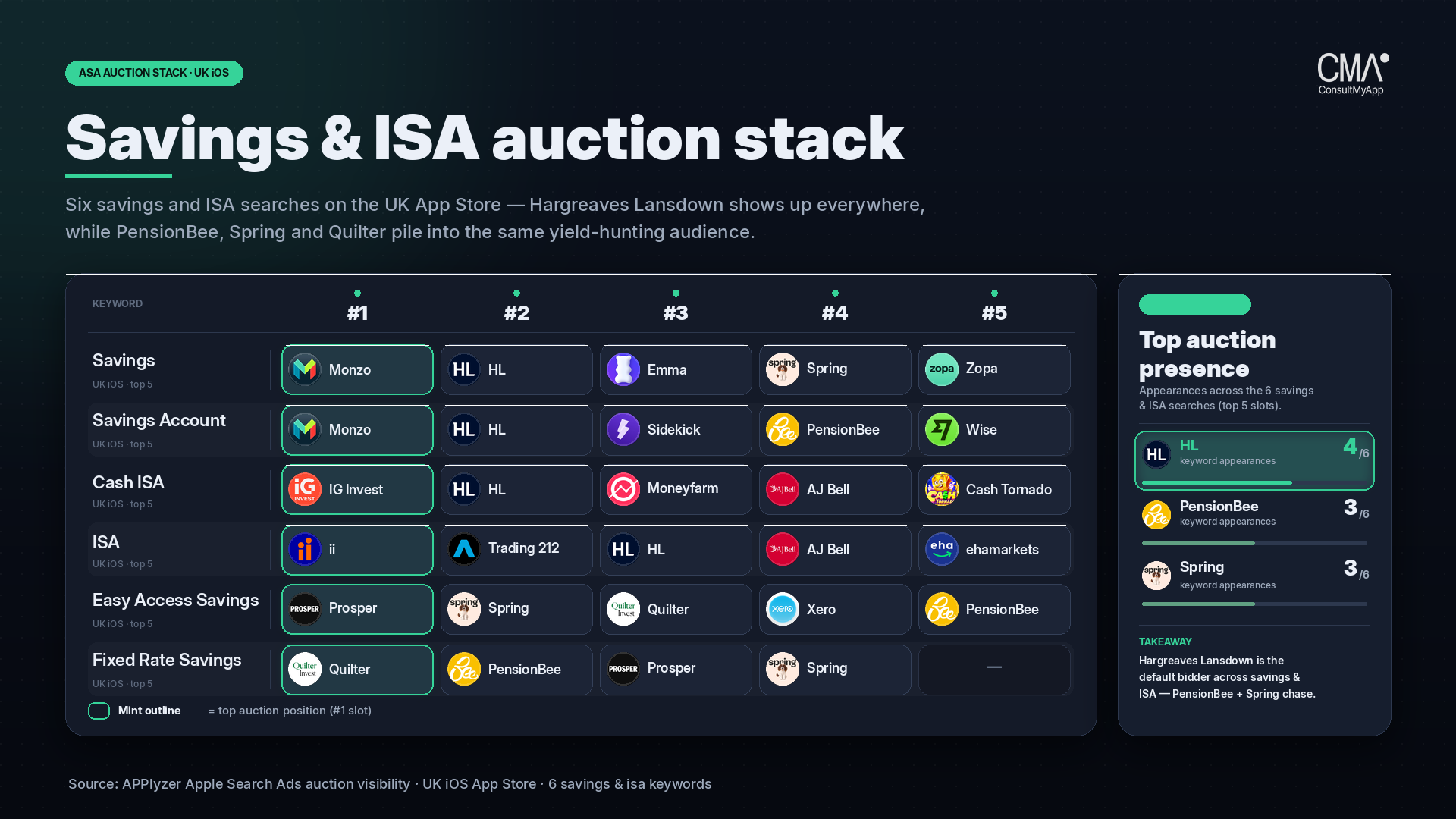
Monzo wins the broad savings layer, appearing in position one for both “savings” and “savings account”.
But once the query becomes more investment or ISA-specific, the market shifts toward specialist wealth and investment brands.
IG Invest, Trading 212, Hargreaves Lansdown, interactive investor and AJ Bell are all highly visible across ISA and stocks-and-shares ISA searches.
This is where the dataset becomes especially useful. “Savings” and “ISA” may sit close together in a user’s financial journey, but they trigger very different competitive sets.
For broad savings searches, challenger banks can compete strongly.
For ISA and investment-led searches, specialist platforms take over.
That distinction matters for campaign structure. Treating “savings”, “cash ISA” and “stocks and shares ISA” as one generic savings cluster would hide the fact that users are likely expressing very different needs.
Mortgage searches are fragmented and noisy
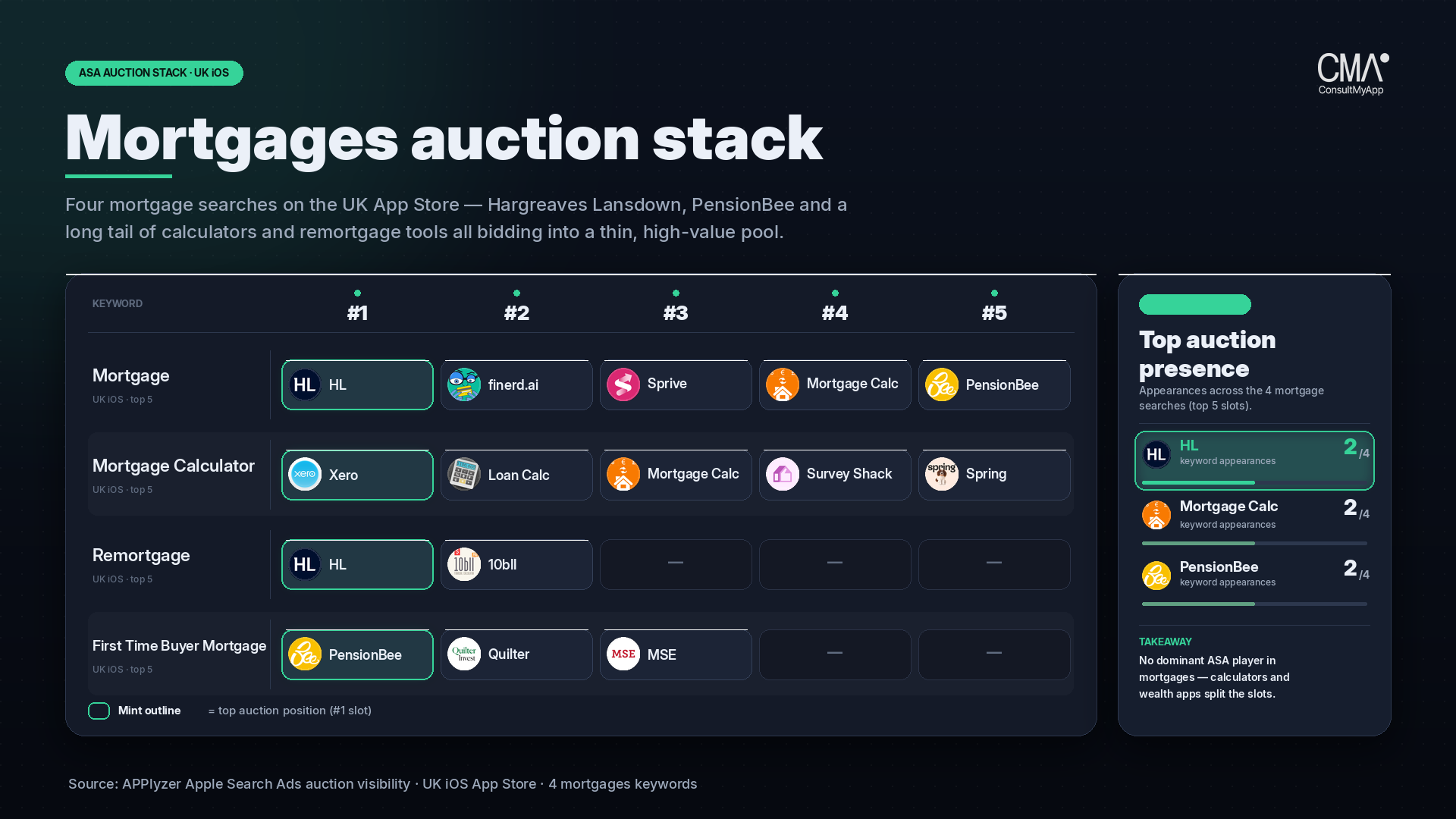
Mortgage-related searches returned a much more fragmented auction picture.
Hargreaves Lansdown appeared in position one for “mortgage” and “remortgage”. Xero appeared first for “mortgage calculator”. PensionBee led “first time buyer mortgage”.
Sprive, mortgage calculator apps, property tools and finance-adjacent brands also appeared across the set.
This does not look like a clean, mature mortgage app auction. It looks more like a broad financial-intent auction where Apple Search Ads is matching several different types of finance and utility apps into mortgage-adjacent demand.
That creates both opportunity and risk.
The opportunity is that mortgage-related searches may be less dominated by a single app brand than core banking or credit score searches.
The risk is that long-tail mortgage terms may produce less precise paid placements, making conversion quality harder to predict.
For marketers, the takeaway is simple: mortgage keywords need tight measurement. A first-place ad impression is only useful if the user intent matches the product promise.
Credit cards and loans are highly competitive, but not always clean
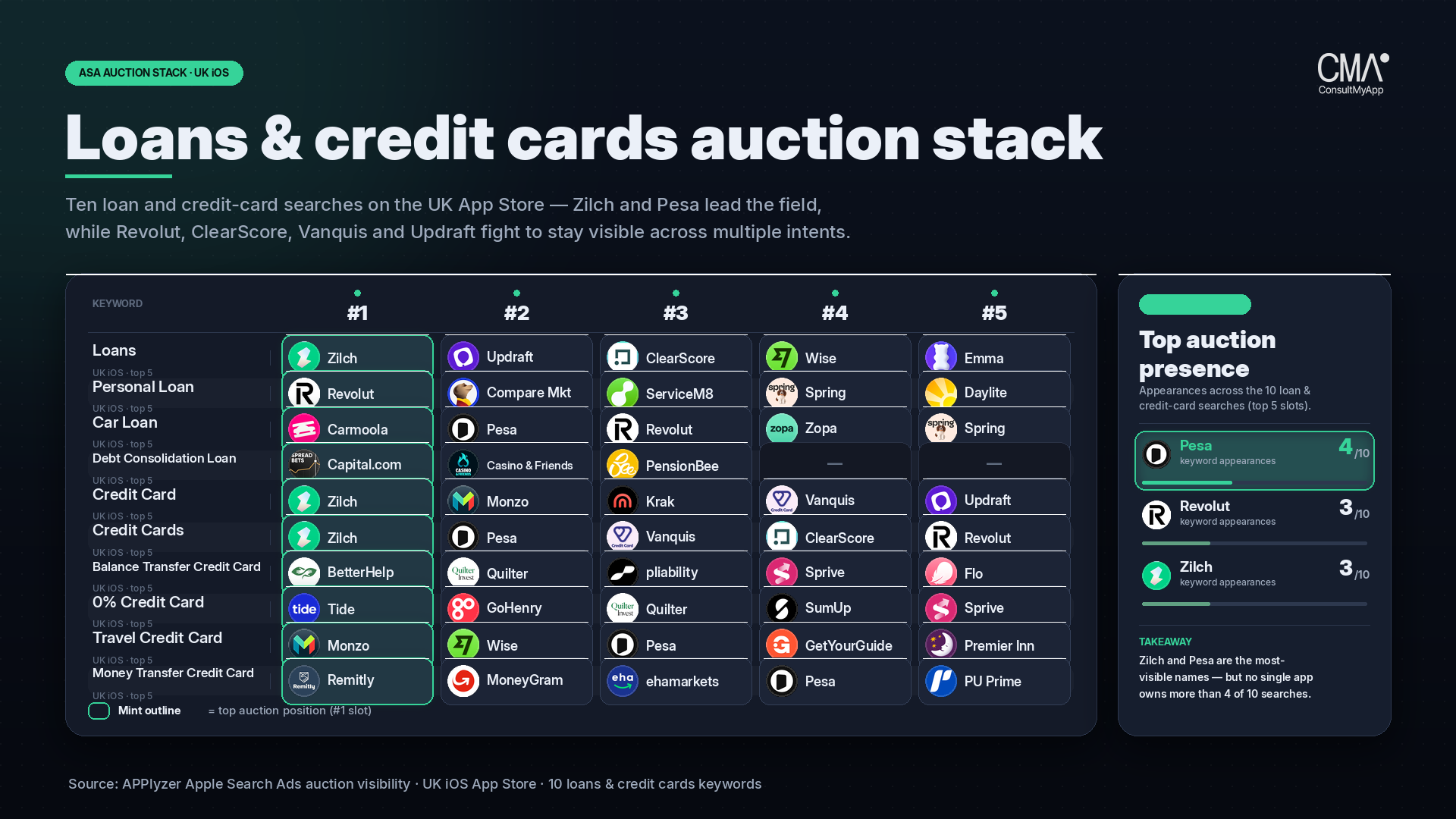
The loans and credit-card space is one of the most mixed parts of the analysis.
Zilch is particularly strong across “loans”, “credit card” and “credit cards”. Revolut appears on “personal loan” and “car loan”. Carmoola leads “car loan”. Vanquis and ClearScore appear in credit-card searches.
But some longer-tail terms also surface unexpected or weakly related apps. “Balance transfer credit card” returned several apps that do not look like obvious credit-card competitors. “Debt consolidation loan” also surfaced results that appear only loosely related to the query.
This is important.
Not every ASA auction result should be treated as a high-quality competitor signal. Some long-tail finance terms appear to attract broad-match or weakly relevant ads.
That does not make the data useless. In fact, it is useful precisely because it reveals auction noise.
For app marketers, this is a reminder that Apple Search Ads optimisation should not stop at impression volume or rank position. Search term quality, conversion rate, tap-through rate and downstream value matter just as much.
Investment apps dominate investment intent
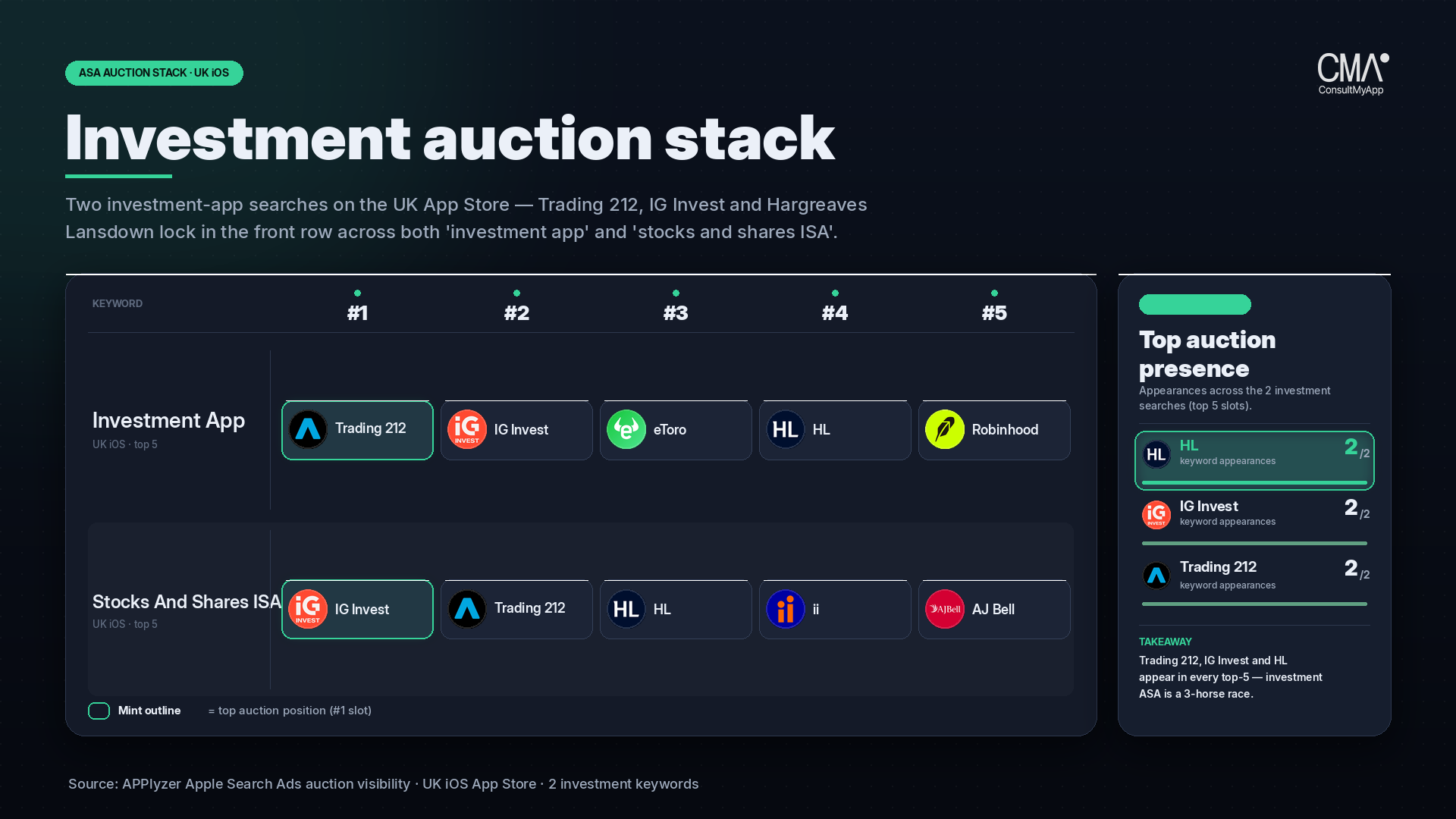
Investment-related searches behave much more cleanly than several of the long-tail credit terms.
Trading 212 won “investment app”, while IG Invest won “stocks and shares ISA” and “cash ISA”. Hargreaves Lansdown, AJ Bell, interactive investor, Moneyfarm, eToro and Robinhood also appeared across investment and ISA searches.
This is a more recognisable competitive set.
It suggests that Apple Search Ads is matching investment intent to investment products more consistently than it does for some broader finance terms.
For app growth teams in wealth, investing or savings, the implication is clear: ISA and investment keywords are commercially valuable but highly contested. Winning those auctions requires more than simply bidding. The product, creative and App Store page need to match the user’s expectation immediately.
Insurance is its own App Store battleground
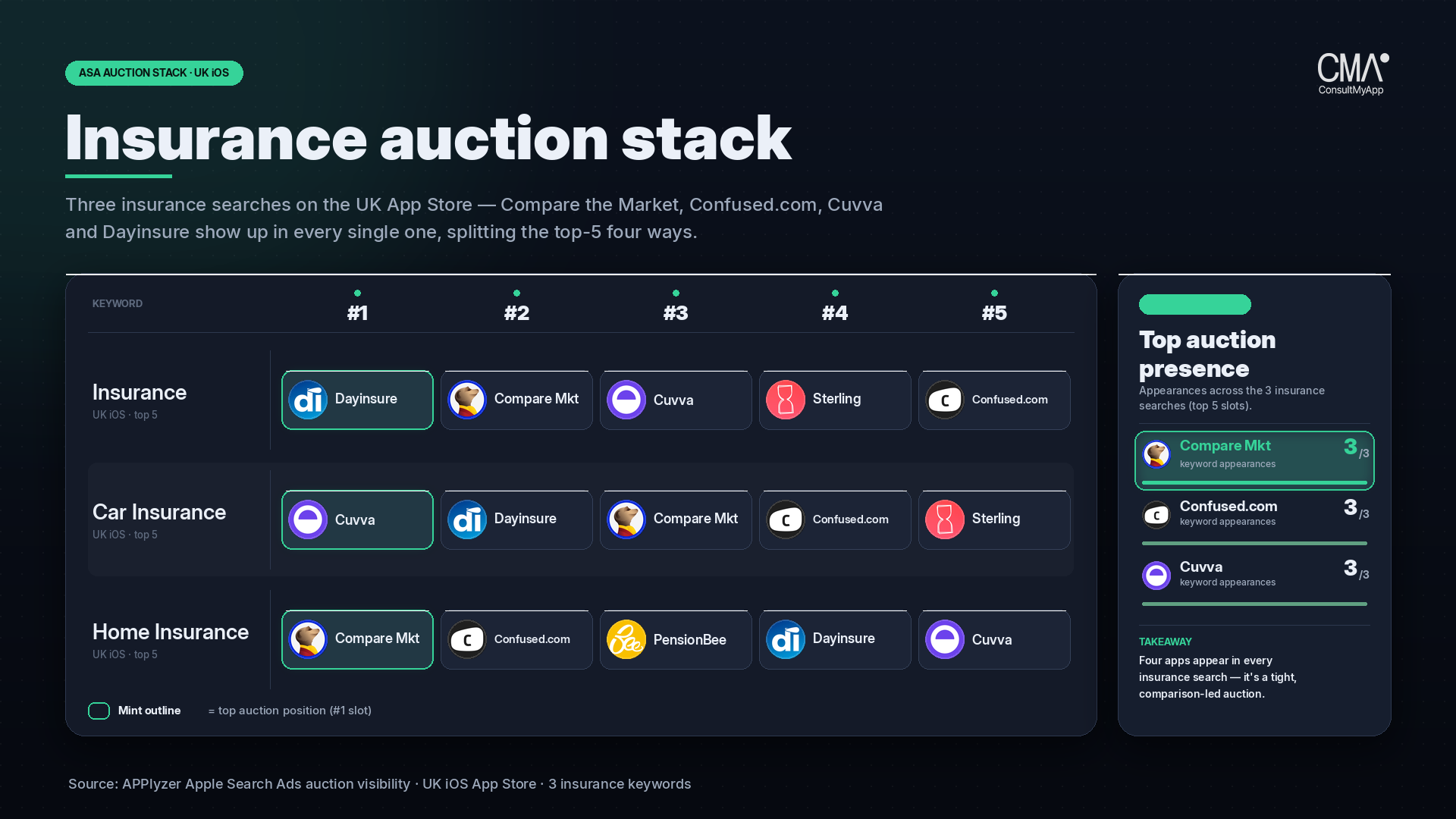
Insurance searches form another distinct market.
Dayinsure, Cuvva, Compare the Market, Confused.com and Sterling Short Term appear strongly across insurance, car insurance and home insurance terms.
This is a very different competitive set from banking, credit cards or investment. It is led by insurance specialists and comparison brands rather than challenger banks.
That reinforces one of the most important lessons from the analysis: Finance is not one market in Apple Search Ads.
It is a collection of intent pools.
Banking, savings, investing, credit cards, mortgages, insurance and credit score searches each have their own auction dynamics. Looking only at total Finance category visibility would miss the point.
Credit score is a specialist category fight
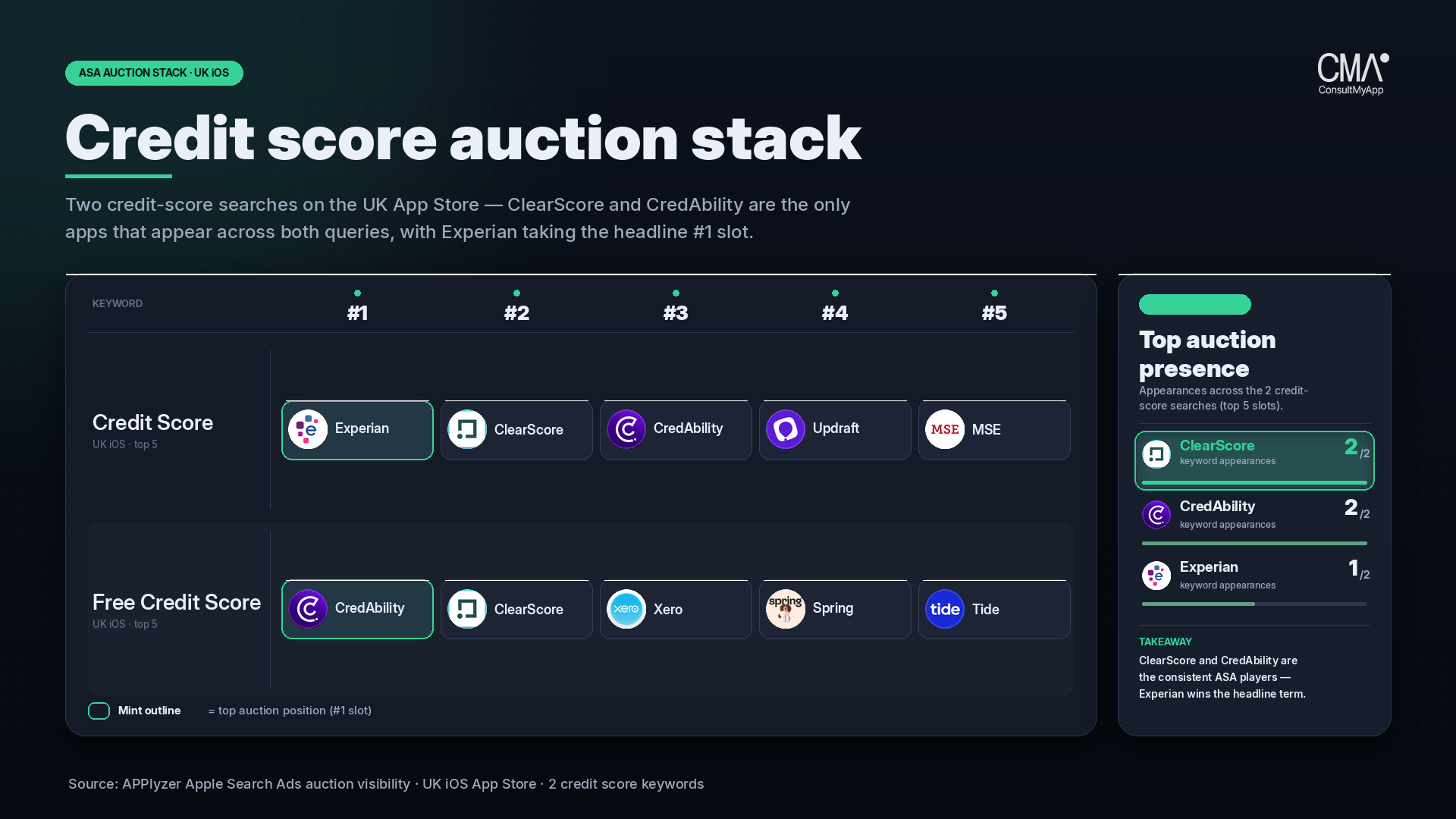
Credit score searches are cleaner and more focused.
Experian won “credit score”, while CredAbility won “free credit score”. ClearScore appeared strongly across both paid and organic results.
This is a good example of a category where brand relevance and search intent are tightly aligned. Users searching for credit score tools are likely looking for exactly that: a credit report, a score, eligibility insights or finance comparison.
Unlike broad banking searches, this is not a market where lots of adjacent brands can credibly stretch their positioning.
For credit-score apps, the challenge is not category ambiguity. It is direct competition.
Buy now pay later and payday loan searches are less predictable
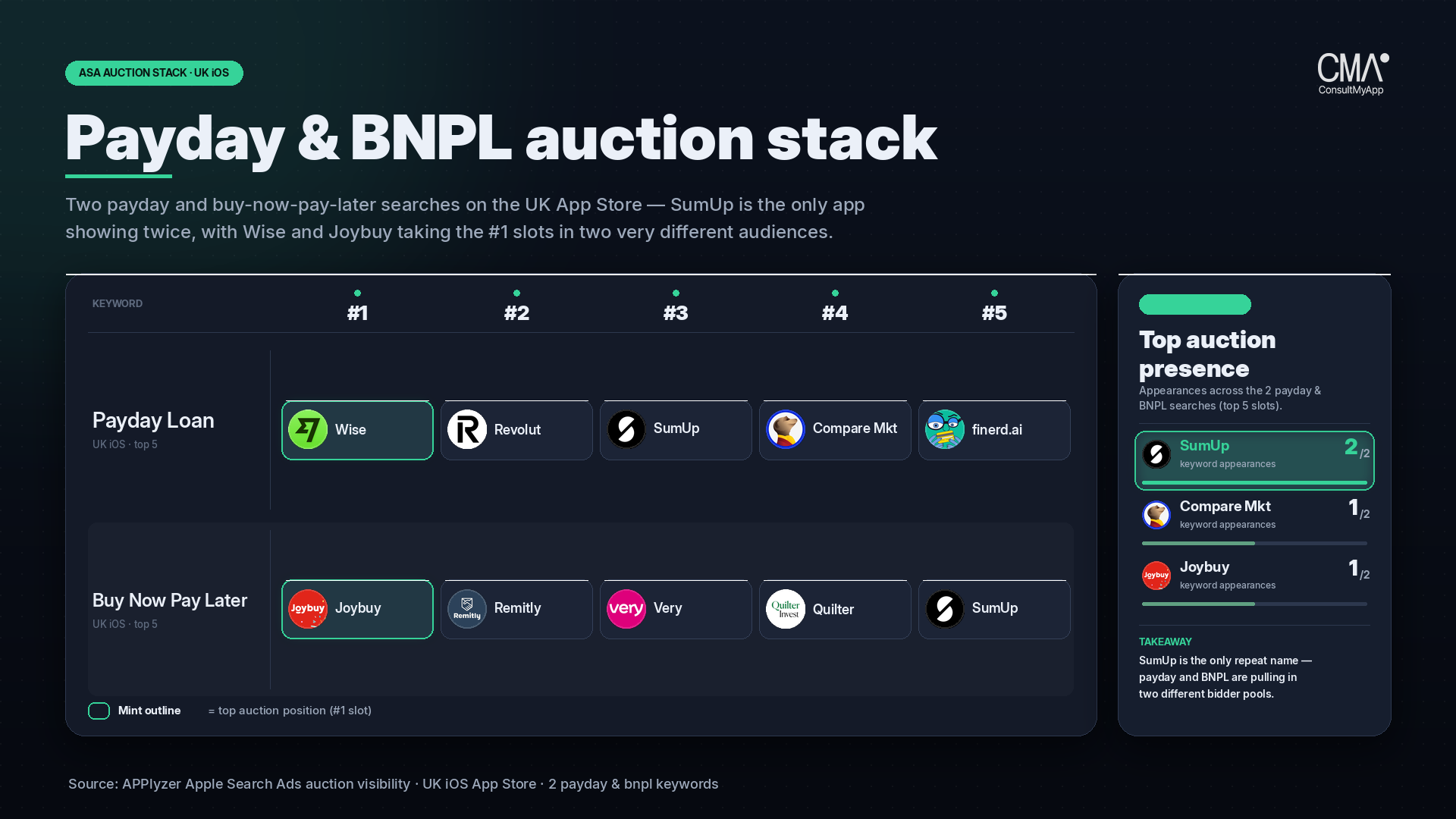
The BNPL and payday loan searches produced some surprising results.
“Buy now pay later” returned shopping, money-transfer, investment and payments apps. “Payday loan” returned Wise, Revolut, SumUp, Compare the Market and finerd.ai.
These results suggest that some high-intent finance terms may not always produce a clean set of product-specific advertisers.
That could be due to broader matching, advertiser targeting choices, limited specialist advertiser density, or Apple’s auction dynamics for certain terms.
For marketers, these queries should be handled carefully. They may generate impressions, but not all impressions are equal. The real test is whether the traffic converts into qualified users.
Paid and organic visibility are telling different stories
The biggest strategic takeaway is that paid and organic visibility are being won by different brands.
In core banking, Starling is a strong organic performer. Monzo and Zopa are more visible in the paid layer.
In savings, Monzo wins broad paid visibility, while specialist apps such as Moneybox, Plum, Chip, Trading 212, Hargreaves Lansdown and IG Invest become more important as the query becomes more product-specific.
In credit score, Experian, ClearScore and CredAbility are tightly aligned across both paid and organic visibility.
In insurance, comparison and specialist insurance apps dominate.
This is why app marketers should not analyse ASO and ASA separately.
Organic rankings show which apps Apple is already rewarding for relevance, authority and conversion signals. Apple Search Ads shows which brands are paying to intercept that same demand.
The best growth strategies understand both layers.
What banking and finance app marketers should take from this
First, Apple Search Ads should be treated as a share-of-intent channel, not just a paid install channel.
The apps winning position one are shaping which brands users consider first.
Second, product-level reporting matters. A brand can look strong in banking but weak in ISAs. It can win savings but lose investment. It can dominate credit score but have no presence in banking.
Third, broad finance keywords and product-specific finance keywords behave very differently. “Banking”, “savings account”, “cash ISA”, “car loan”, “mortgage calculator” and “insurance” should not be analysed as one generic Finance keyword group.
Fourth, lower auction positions still matter. Apps repeatedly appearing in positions three to five may not be winning the most valuable impressions, but they reveal where brands are testing expansion, defending territory or stretching into adjacent intent.
Finally, noisy auctions need to be identified rather than ignored. Some long-tail finance searches return apps that are not obvious product competitors. Those results should be treated as a targeting and relevance warning, not just a share-of-voice datapoint.
Final answer: who is winning Apple Search Ads in UK Financial Services?
Monzo is the clearest paid winner in core UK banking.
It owns several of the most valuable first-position placements across bank account, online banking, bank app, current account and savings searches.
Zopa is the strongest paid challenger in generic banking discovery.
Starling remains the organic benchmark for core banking visibility.
But the broader finance market is much more fragmented than the headline suggests.
IG Invest, Trading 212, Hargreaves Lansdown, interactive investor and AJ Bell become highly important in ISA and investment searches.
Zilch is prominent across loans and credit-card intent.
Dayinsure, Cuvva, Compare the Market and Confused.com lead the insurance layer.
Experian, ClearScore and CredAbility define the credit-score fight.
The conclusion is not simply that one app is winning UK finance.
It is that Apple Search Ads in Finance is now a product-intent battlefield.
The brands that win will be the ones that understand where they need to buy demand, where they already earn organic visibility, and where their App Store product page is strong enough to convert the intent they are paying to capture.
Want to accelerate the growth of your FinTech app in a sustainable & profitable way?
We’d love to chat :-) Please feel free to reach out to us here and one of our team will be in touch!