The AI race between ChatGPT and Gemini in the App Store - who’s winning so far?
If you only follow AI headlines, you’d think the “assistant wars” are being won in keynote decks and model benchmarks. In reality, there’s a more ruthless battleground: a 6-inch screen, a search box, and a user who types one word:
“ChatGPT”
Or worse (for OpenAI at least): a competitor’s name.
In this post, we look at how ChatGPT vs Google Gemini are competing inside the iOS App Store (US, iPhone), using a snapshot of:
Organic search rankings (who shows up where)
Apple Search Ads auction stacks (#1–#5) (who is paying to show up where)
A mix of brand and generic “AI assistant” terms
Dataset: App Store + Apple Search Ads snapshots captured 2026-03-03 (US / iPhone / en-US) through APPlyzer.
Key takeaways (for app marketers)
✅ They’re both conquesting. Each app ranks on the other’s brand term organically.
✅ “chatgpt” is a paid warzone and Gemini is all over the paid Apple Ad stack.
✅ ChatGPT is the default noun on generics (e.g. “ai assistant”, “chatbot”).
✅ Gemini’s paid strategy looks more aggressive on non-brand (in this snapshot it appears in the top-5 ads for “ai assistant”).
⚠️ “Gemini” is a messy keyword (multi-intent), so both organic and paid results can look weird.
1) Brand terms: yes, they’re crashing each other’s party (organically)
Let’s start with the simplest question:
Do they rank for each other’s brand terms organically?
They do - and not subtly.
On “chatgpt”, ChatGPT ranks #1 (no shock)… but Google Gemini ranks #4.
On “gemini”, Google Gemini ranks #1… and ChatGPT ranks #2.
On “google gemini”, Gemini is #1 and ChatGPT is #2.
That’s not “accidental relevance”. That’s what brand gravity looks like when the category is still forming and users are actively comparing products.
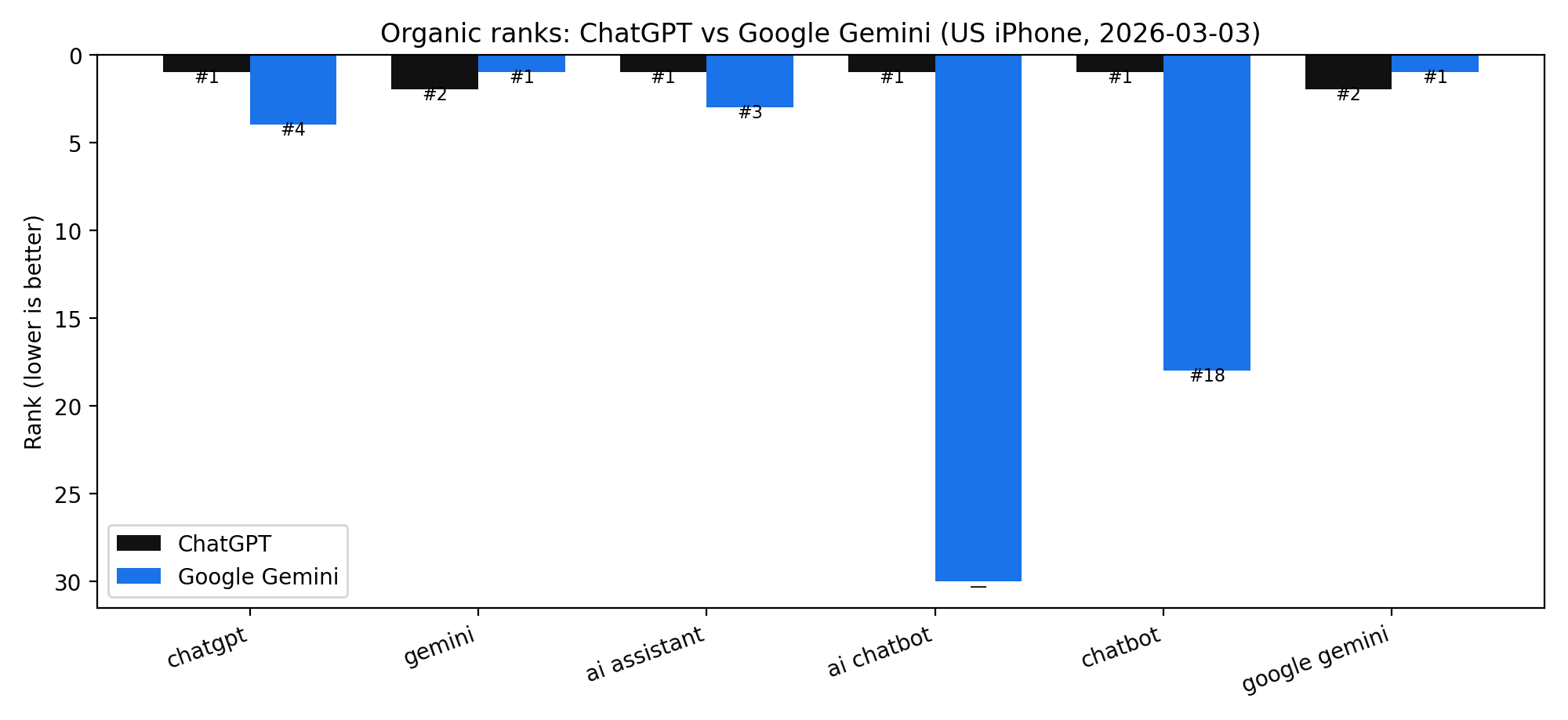
Organic ranks head-to-head across brand + generic terms (US iPhone, snapshot 2026-03-03)
What else is happening on “chatgpt”?
The “chatgpt” SERP isn’t just the two giants. It’s also a swarm of brand-parasite and generic chat apps sitting right underneath the leader, which is exactly why brand defence (paid + organic) gets expensive fast.
2) Apple Search Ads: “chatgpt” is UFC… and Gemini is in the cage
If organic search is a street fight, Search Ads is UFC: everyone’s in the cage and Apple’s taking a cut.
Are they appearing in the paid stack for each other’s brand terms?
On “chatgpt”, the top-5 Apple Ads stack is:
ChatGPT
Google Gemini
Microsoft Copilot
ChatGOAT (3rd party)
Chat Smith (3rd party)
Meaning: Gemini isn’t just ranking organically on “chatgpt”, it’s also buying a seat in the paid stack. That’s classic conquest behaviour.
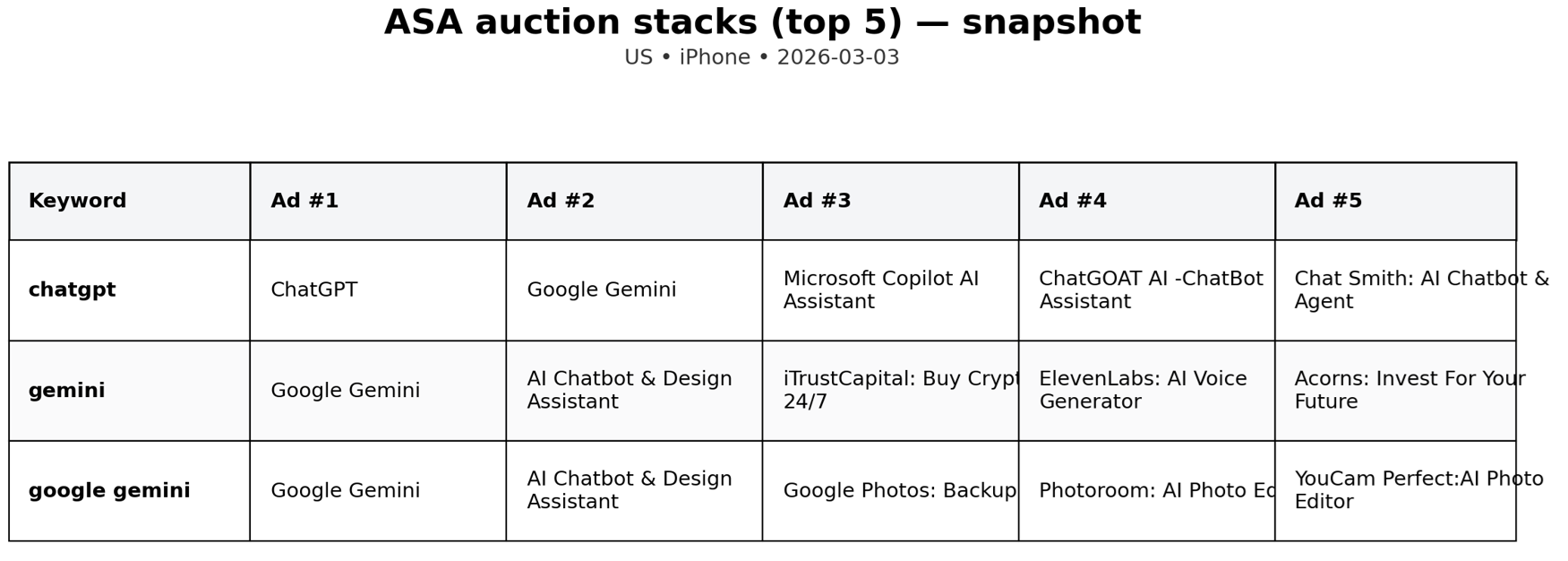
The Apple Ads auction results #1-#5 (not just the winners)….
On “gemini”, the paid stack is… chaotic. Gemini is there, but the rest includes apps that clearly aren’t “AI assistant” competitors. That usually happens when a keyword has multiple meanings / intents.
My take
ChatGPT is doing the obvious defensive thing: showing on “chatgpt”.
Gemini is doing the aggressive thing: showing on “chatgpt” too.
“Gemini” as a keyword is not clean brand intent, so be cautious interpreting both paid + organic there.
3) Generic keywords: ChatGPT is winning default visibility but Gemini is pushing paid coverage
Brand is nice. But generic demand is where scale lives.
Organic: “AI assistant” is basically a leaderboard
On “ai assistant” (organic, US iPhone):
#1 ChatGPT
#3 Google Gemini
#7 Microsoft Copilot
Plus Grok, Claude, Perplexity, DeepSeek and more
This is one of the cleanest “category SERPs” in the dataset: it reflects real user intent (productivity / assistant), and the leaders are showing up.
Organic: “AI chatbot” and “chatbot” are not the same intent
On “ai chatbot”, the SERP leans heavily toward character/roleplay and social-chat apps. That’s a reminder that:
“assistant” ≠ “chatbot” in user intent
“chatbot” terms on iOS have been heavily colonised by companionship / roleplay products
And yet… on “chatbot”, ChatGPT is still #1, and Gemini is #18 (still page-one-ish depending on device/layout).
Apple Ads: Gemini shows up on “ai assistant” (ChatGPT doesn’t)
In the top-5 paid stack for “ai assistant”, Gemini appears (position #3), while ChatGPT does not.
That doesn’t mean ChatGPT never bids there, it just means that in this daily snapshot, Gemini is the one visibly paying to sit on that generic intent.
This is exactly why auction-stack visibility matters: winner-only views miss most of the story.
4) So… who’s winning in the App Store so far?
If we define “winning” as share of visibility across your own brand term, your competitor’s brand term, and the biggest generic assistant terms, this snapshot reads like:
ChatGPT is winning on organic visibility
Dominant positions on core generics (e.g. #1 on “ai assistant”, #1 on “chatbot”)
Massive brand gravity (“chatgpt” as the default query behaviour is doing a lot of work)
Strong presence even on competitor-branded intent (#2 on “gemini”, #2 on “google gemini”)
Gemini is winning on paid aggression (and brand defence where it matters)
#1 on “gemini” (organic)
In the paid stack on “chatgpt” (conquesting)
In the paid stack on “ai assistant” (generic intent coverage)
The real story
It’s a two-layer war. Organic + paid together suggests both teams understand the same truth: in 2026, the App Store search box is a competitive shelf, not a directory.
5) What app marketers should steal from this
Treat brand terms like a product, not a keyword
Brand terms attract parasites, resellers, and competitors. Defence is both ASO (organic) and ASA (paid) - you really need both.
Track the full Search Ads stack (#1–#5), not just the winner
If you only see winners, you miss conquest behaviour. “Always present” strategies often sit in positions #4–#5, and they still steal share.Handle multi-intent keywords like “Gemini” with extreme care
Polysemous terms attract irrelevant competitors and weird auctions. Separate brand intent from broad reach noise.Segment “assistant” vs “chatbot” as different intents
“Assistant” SERPs tend to be productivity-led. “Chatbot” SERPs can be roleplay/companionship-led. If your product is an assistant, don’t blindly chase chatbot terms without measuring conversion quality.
Quick stats table (US iPhone, snapshot 2026-03-03)
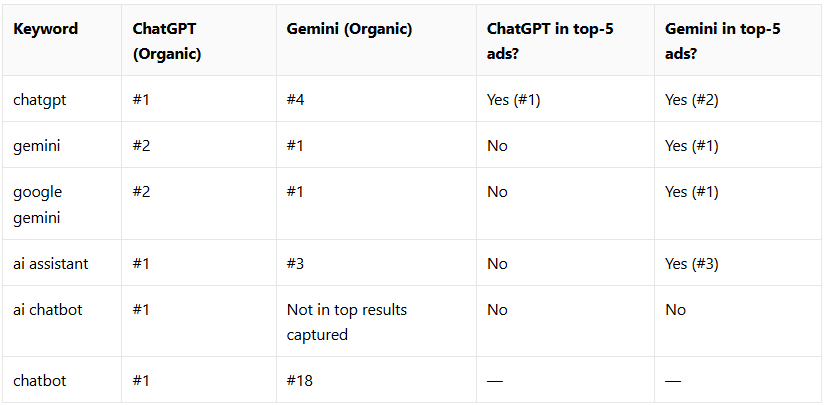
Note: Paid stacks were captured for a subset of keywords in this dataset.
Methodology & notes
Market: iOS (United States)
Device: iPhone
Locale: en-US
Data Source (organic & Apple Ads): APPlyzer
Snapshot date: 2026-03-03
Organic ranks: App Store search results snapshot (top results captured per keyword)
Paid stacks: Apple Search Ads snapshot of the top-5 ads returned per keyword at capture time
Interpretation caution: “Gemini” is a multi-intent keyword, so organic and paid results may include unrelated apps
FAQ: App Store conquesting & Search Ads stacks
Is it “normal” to show up on competitor brand terms?
In fast-moving categories, yes - especially when users actively compare options and Apple’s relevance systems treat the apps as substitutes. The more “category-defining” the keyword, the more this happens.
Why do unrelated apps appear in the “gemini” paid stack?
Because “Gemini” can mean multiple things. When intent is mixed, auctions can pull in advertisers chasing reach (or matching a different meaning entirely).
What’s the practical takeaway for ASO + ASA teams?
Don’t run them as separate workflows. Brand defence, conquesting, and generic coverage all interact with organic positioning, and you can waste a lot of budget paying for installs you would have earned organically.
What should I monitor weekly if I’m in a competitive category?
Organic rank movement on your brand term + top category generics
Auction stack presence (#1–#5) for your brand and highest-volume generics
New entrants showing up on your brand term (especially repeat presence)
Want to look at the data for yourself? Feel free to have a play with APPlyzer 26 (our go-to data provider) for free today - www.applyzer.com
Alternatively, if you’re looking for an award-winning agency to transform your app’s store visibility, we’d be delighted to have a conversation with you - please contact us and one of the team will reach straight out for a chat!
Looking for more App Marketing News, Views & Guides? Why not check out our sister publication - www.appstoremarketing.com which follows all the latest from major agencies, forums and of course Apple & Google themselves :-)