Who is winning the mobile AI race? Well, it depends where you look…
ConsultMyApp | Research cut-off: 4 October 2026 | US iPhone and Android apps
Every few weeks we're told another AI model has changed everything. By the time you've tried it, someone else has launched a better one. Apparently. I wanted to see what was happening in the app stores, where people actually have to choose what to download.
So we looked at a year of US app-store data for ChatGPT, Gemini, Claude, Grok, DeepSeek and Perplexity, plus Meta's Muse. We also checked search visibility, Apple Ads and what happened to downloads around the big model announcements. There are a few surprises in here.
ChatGPT comes out comfortably ahead on estimated downloads. Gemini is much more visible in our nonbrand Apple Ads searches, while Muse has made an impressive start on iPhone. If you were hoping for one winner to settle the argument, sorry about that.
Downloads: ChatGPT is comfortably out in front
Across our US comparison from 5 October 2025 to 4 October 2026, ChatGPT's combined download estimate is more than three times Gemini's. That's quite a gap.
Gemini takes second place, followed by Claude, Grok, Perplexity and DeepSeek.
Assistant | iPhone estimated downloads | Android estimated downloads | Combined estimated downloads |
|---|---|---|---|
ChatGPT | 90,927,084 | 82,658,564 | 173,585,648 |
Gemini | 43,920,935 | 10,513,123 | 54,434,058 |
Claude | 28,455,155 | 13,993,781 | 42,448,936 |
Grok | 18,447,437 | 9,142,819 | 27,590,256 |
Perplexity | 4,107,971 | 10,509,866 | 14,617,837 |
DeepSeek | 1,631,573 | 5,729,625 | 7,361,198 |
Source: APPlyzer US download estimates for the comparison sample. These are not complete annual installs or unique users.
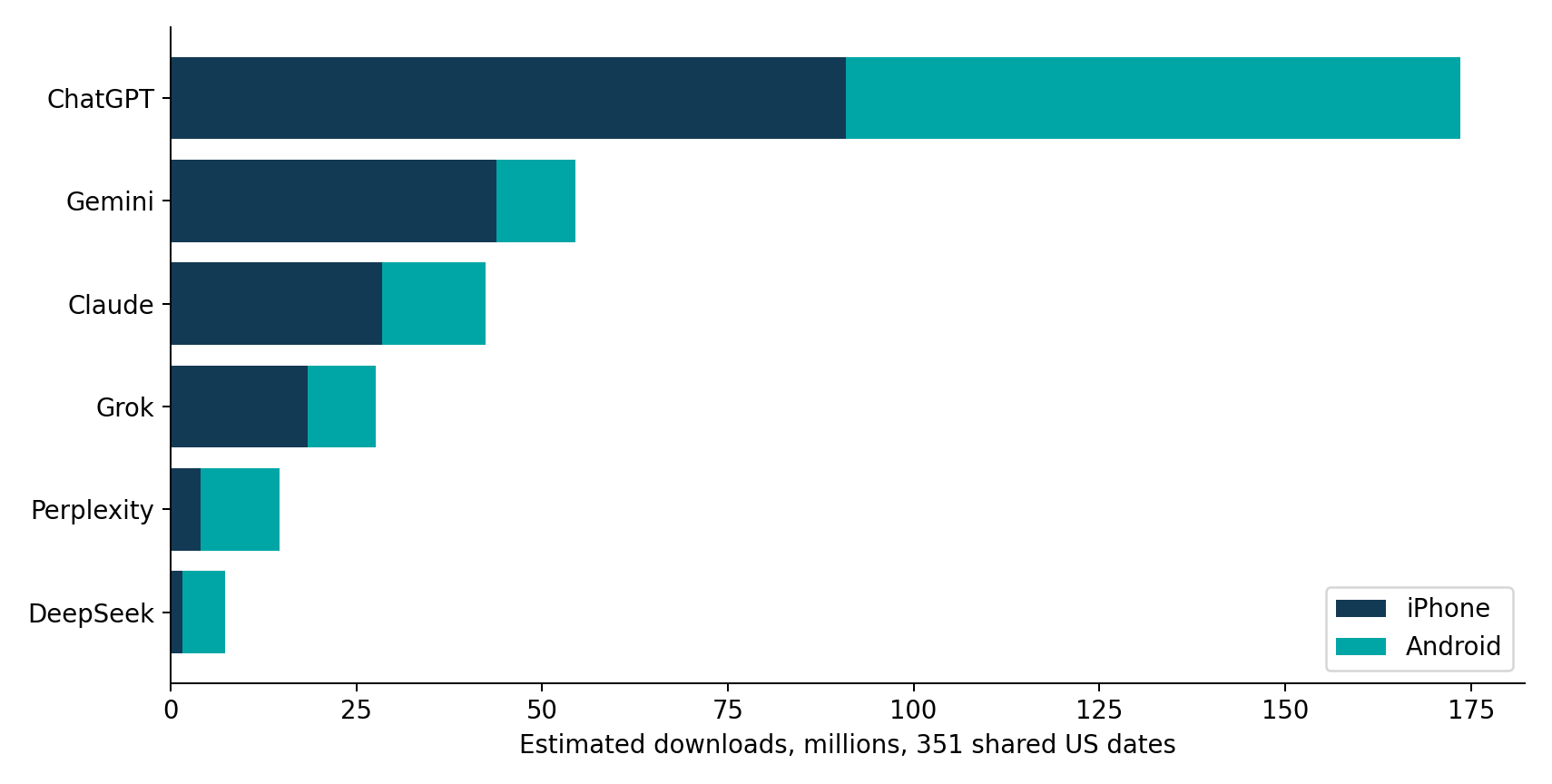
But have a look at the platform split before declaring the race over. Gemini gets much of its total from iPhone, while Claude is second on Android despite finishing third overall. Perplexity is much stronger on Android too. Quite useful to know if that's where your customers are.
Perplexity and Gemini are particularly close on Android. They swap places in our alternative comparisons, so I wouldn't make too much of the gap between them.
Downloaded it. But did they come back?
We've all downloaded an app, opened it once and then forgotten it existed. Getting to the top of the charts is useful, of course, but it doesn't tell us whether people are coming back.
ChatGPT's median iPhone rank is 1, with Gemini at 3 and Grok at 15. The other assistants are further down the table. ChatGPT has rather made itself at home at the top.
Assistant | Median overall free iPhone rank |
|---|---|
ChatGPT | 1 |
Gemini | 3 |
Grok | 15 |
Perplexity | 170 |
Claude | 278 |
DeepSeek | 414 |
Source: APPlyzer overall free-chart rankings for the comparison sample. Lower is better.
Android looks good for ChatGPT too: a median rank of 1, with 261 days at number one in the data.
Interestingly, all six assistants had lower Android download estimates at the end of the study than at the start. Gemini's final 28-day figure was roughly a quarter of its opening figure; ChatGPT's was around three-quarters. That tells us downloads slowed. It doesn't tell us what happened to the people who had already installed the apps.
I'd want to see retention data before judging how healthy any of these products really are. The store figures can only take us so far.
Muse has entered the chat
Meta announced Muse's US rollout on 8 September 2026. The Muse from Meta iPhone app gives us an early look at its mobile momentum. Muse Spark is its underlying model, rather than a separate app.
Muse picked up an estimated 6,507,227 US iPhone downloads between 8 September and 4 October. Not a bad entrance.
It also spent 15 days at number one and stayed in the top ten throughout its chart sample, with a median rank of 1. I'd certainly be keeping an eye on it.
The Android app adds another useful view: APPlyzer estimates 4,938,712 US downloads for the package from 12 September to 4 October.
Put Muse alongside the other assistants in the early-launch comparison and it's already second. ChatGPT still leads, but Meta has given it something to think about.
App / package | iPhone estimate | Android estimate | Combined estimate |
|---|---|---|---|
ChatGPT | 7,481,796 | 4,272,406 | 11,754,202 |
Muse (Android: com.facebook.aura) | 5,791,315 | 4,395,280 | 10,186,595 |
Gemini | 1,927,101 | 372,423 | 2,299,524 |
Claude | 1,655,681 | 573,619 | 2,229,300 |
Grok | 823,870 | 358,915 | 1,182,785 |
Perplexity | 95,871 | 425,145 | 521,016 |
DeepSeek | 32,631 | 300,579 | 333,210 |
Source: APPlyzer US estimates, September–October 2026. Muse's Android figures refer to com.facebook.aura; package downloads are not necessarily new Muse users.
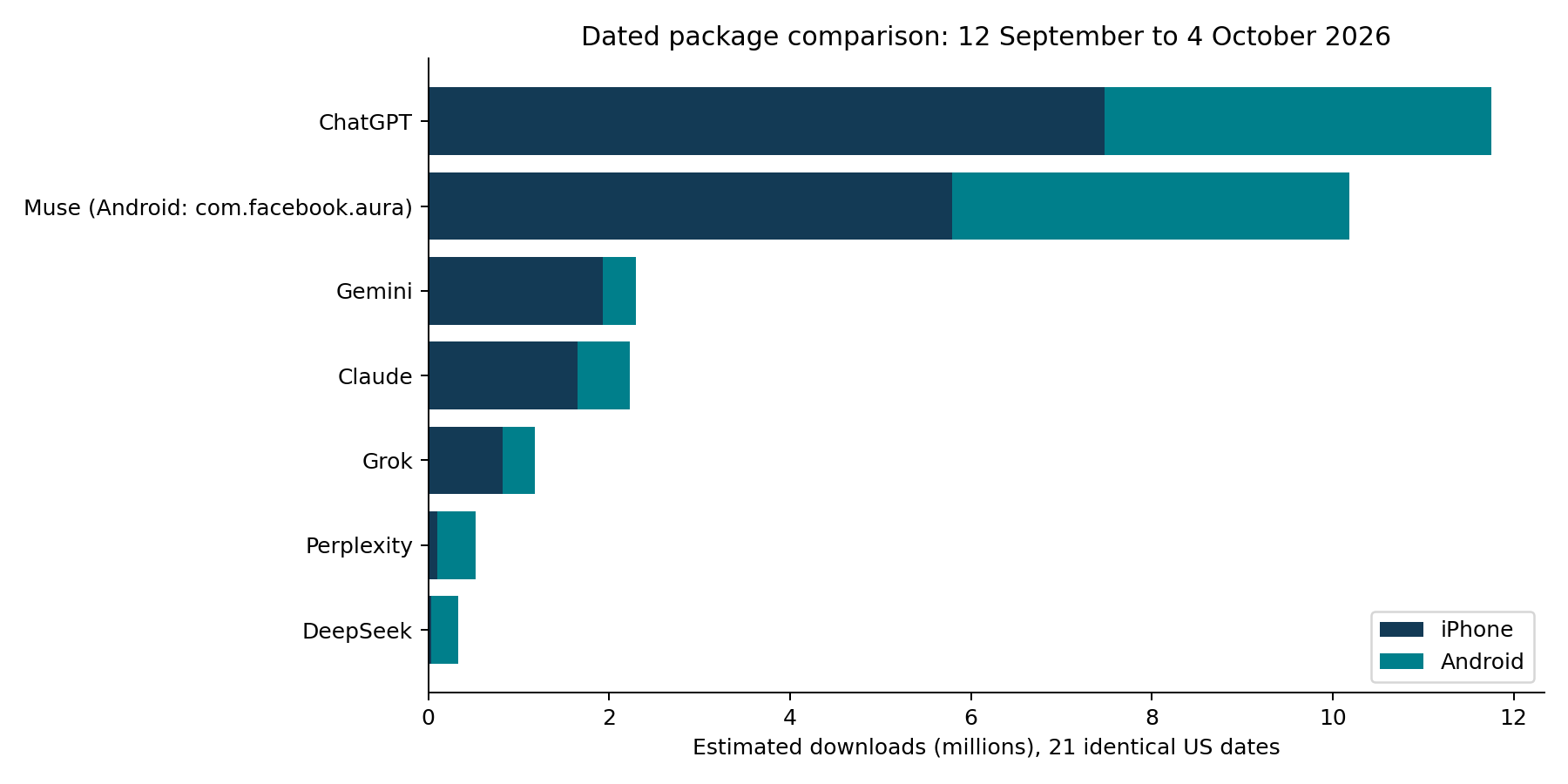
One thing to be careful about here: the Android numbers cover an existing package. We can't count all of those downloads as new Muse users. The iPhone start is impressive in its own right, though, and it'll be interesting to see how much of that initial interest sticks.
Search: being famous is not the whole story
We checked 100 US search phrases, including 70 searches for a category or task rather than a named assistant. Think about someone looking for help with a job, rather than someone who already knows they want ChatGPT. Who do they find?
ChatGPT leads our nonbrand search-visibility index on both stores. Grok comes second among the seven assistants on iPhone.
Store | ChatGPT visibility index | Share of all returned-app index |
|---|---|---|
iPhone | 12.26 | 3.11% |
Android | 12.24 | 4.03% |
Source: APPlyzer US search-result snapshots. The index measures search visibility, not search traffic or verified organic share of voice.
If those percentages look small, remember how many other apps are competing for the same searches. ChatGPT has 29.87% of the iPhone index when we look only at our seven assistants, but 3.11% when we include every app returned. There's a lot more competition out there than the usual AI headlines suggest.
ChatGPT stays ahead in our alternative keyword checks too. Still, there's plenty of room for other apps to get found.
Gemini is getting itself noticed in Apple Ads
Gemini appeared on 34 of our 70 nonbrand Apple Ads searches, more than any other advertiser in the sample. Google is clearly showing up here, even where its app isn't leading the download table.
Named assistant | Nonbrand phrases with Apple Ads presence | Valid phrases | Presence rate |
|---|---|---|---|
Gemini | 34 | 70 | 48.57% |
Claude | 13 | 70 | 18.57% |
Muse | 13 | 70 | 18.57% |
Perplexity | 10 | 70 | 14.29% |
ChatGPT | 9 | 70 | 12.86% |
Grok | 8 | 70 | 11.43% |
DeepSeek | 0 | 70 | 0.00% |
Source: APPlyzer US iPhone Apple Ads snapshots. Presence is counted once per app/keyword. This is not advertising spend, impressions or auction impression share.
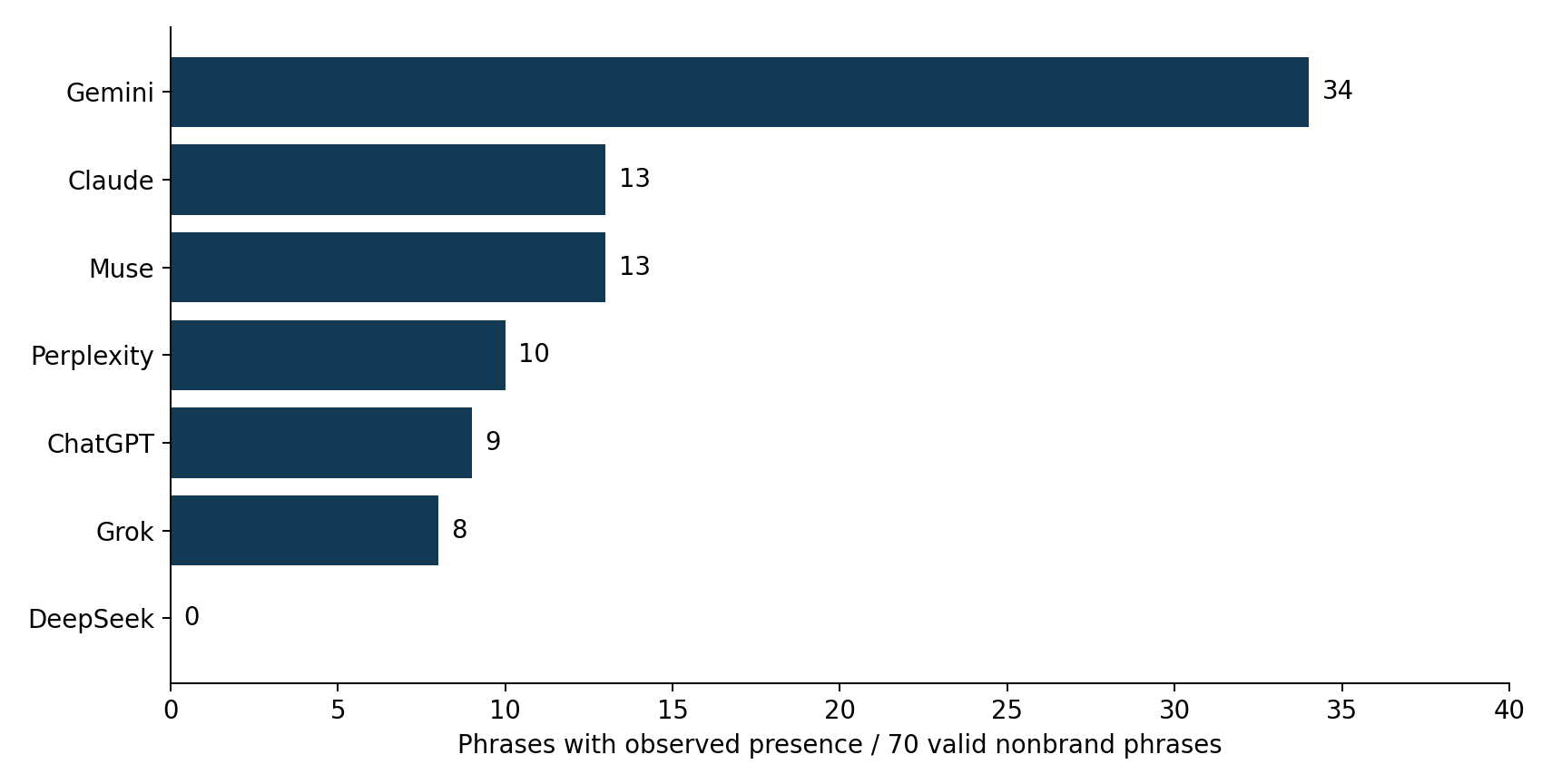
Gemini accounts for 9.86% of all advertiser app-keyword appearances and 39.08% among the seven assistants. Meanwhile, ‘Use AI: Chat Assistant & Agent’ appeared on 26 phrases. Not a name that gets quite as much airtime, but it was certainly getting in front of people.
Our weighted keyword check keeps Gemini in first place. DeepSeek didn't appear in this sample, although that doesn't mean it never advertises elsewhere.
If you're planning acquisition, I'd look at search results and paid ads separately. ChatGPT leads our search-visibility index; Gemini appears on the most nonbrand Apple Ads phrases. Assuming the download leader owns both would send you in the wrong direction.
Does a shiny new model bring more downloads?
You'd think a big model launch would send everyone rushing to download the app. The results are a bit less obliging.
These are the changes in average daily download estimates across the two weeks before and after selected announcements:
Announcement | Date | iPhone before/after change | Android before/after change |
|---|---|---|---|
Gemini 3 Pro | 18 Nov 2025 | +44.5% | +71.2% |
GPT-5.2 | 11 Dec 2025 | +8.9% | +8.8% |
Gemini 3 Deep Think upgrade | 12 Feb 2026 | +27.4% | -25.9% |
Source: APPlyzer estimated downloads. Before-and-after changes show associations, not proof that a model launch caused them.
Downloads rose substantially around Gemini 3 Pro on both stores, with smaller gains around GPT-5.2. Deep Think went up on iPhone and down on Android. Around Claude Opus 4.6, Android downloads fell 60.7%. I wouldn't use that last figure to judge the model itself, but it does make the launch-day victory laps look a little premature.
There's usually other activity going on at the same time. Gemini's August study-notebook announcement coincided with a US student promotion, for example. Paid campaigns, distribution and rival releases can also move downloads, so we can't give the model announcement all the credit (or blame).
So what would I do with all this?
For me, the platform differences are the most useful part of this. ChatGPT leads the US download comparison, Gemini is particularly strong on iPhone, and Claude's second place on Android is easily missed. If you're building or marketing an app, those differences matter much more than deciding who gets to wear the AI crown this week.
I'd also keep Muse on the watchlist. It has had a good start on iPhone, and the next question is how many of those people keep using it.
For your own app, I'd ask three separate questions: are people finding it, are they downloading it, and do they come back? These figures help with the first two. You'll need your own product data for the third.
And by all means enjoy the next model launch. Just don't throw out your growth plan every time someone announces a new decimal point.
A quick note on the numbers
Research note: We used APPlyzer's US download estimates, store rankings and keyword snapshots from 5 October 2025 to 4 October 2026. The comparisons use like-for-like samples, not complete annual totals. Downloads aren't active users, visibility isn't traffic or ad impression share, and a change around a launch doesn't prove the launch caused it.
Sources
- APPlyzer: estimated downloads, chart observations and keyword/Apple Ads snapshots.
- Meta: introducing Muse and Apple: Muse from Meta: product and rollout context.
- OpenAI: ChatGPT release notes, Google: Gemini release notes and Anthropic: Claude Opus 4.6: announcement context.