
How does my metadata impact Apple Search Ads performance & auction position?
Research by CMA / APPlyzer | US App Store | Updated 4 August 2026
→ Your title appears to matter (a lot!)
→ Screenshots might seem important until you factor in the size of the publishers that made them.
→ Custom Product Pages are not a free pass to the front of the auction.
This APPlyzer study combines 56,063 auction-position observations from 569 captured full auction stacks (top 100 auction positions) across a number of popular US App Store search terms with 28,449 metadata-bearing observations and a visual audit of 1,910 screenshots.
We scored titles, subtitles, long descriptions, default screenshots and Custom Product Pages (CPPs) against the keyword being auctioned, then tested how those scores related to average auction position.
The keyword set was concentrated in casino and social-casino terms rather than exhaustive, so broader categories may change the size of the effects, although we do not expect them to reverse the central pattern - title relevance has a robust relationship with auction position; screenshots and CPP usage are much more entangled with bid, advertiser quality and conversion performance.
What does Apple say determines auction position?
Apple now calls the platform Apple Ads (although marketers still search for Apple Search Ads and ASA). Apple publicly says that whether a search-results ad displays over competing advertisers depends on a combination of app relevance to the query and the keyword bid. An app that is not relevant will not be shown, regardless of bid, and advertisers cannot select or bid for a particular position. Read Apple's search-results guidance.
Apple is less specific about what sits inside relevance. Search Match explicitly uses App Store listing metadata, information about similar apps and other search data. That confirms metadata is part of the matching system, but Apple does not publish weights for the title, subtitle, description or screenshots. Read how Search Match uses metadata.
CPPs are positioned as a way to align creative with keyword themes and audiences. That is a sensible reason to expect better tap-through and conversion performance. It is not the same as Apple promising an auction-rank bonus. There is no checkbox labelled "I made a CPP, please move me to position 3". Read Apple's ad-variation guidance.
How did we score relevance?
Each relevance score runs from 1 to 100. It is a comparative APPlyzer diagnostic, not a reconstruction of Apple's private score. The metadata model weights title relevance at 50%, subtitle at 20% and long description at 30%. The visual model uses the actual uploaded screenshots, visible text, layout, colour, texture and casino/slots imagery. Screenshot 1 receives 40% of the page score, screenshot 2 receives 25%, screenshot 3 receives 15%, and the remaining assets share the final 20%.

The visual audit decoded all 1,910 supplied screenshots and matched 97.8% of metadata observations to an analysed product page.
Do more relevant listings rank higher?
Yes - very clearly in the raw data. Apps in the highest screenshot-relevance quintile averaged auction position 39.3, compared with 72.5 for the lowest quintile. The highest metadata-relevance quintile averaged 42.7, compared with 70.6 for the lowest. Higher relevance scores were also associated with a much higher chance of appearing in the top 10.
The raw Spearman correlation was -0.418 for screenshot relevance and -0.352 for metadata relevance. The minus sign is good here: a higher relevance score is associated with a lower, better auction position.
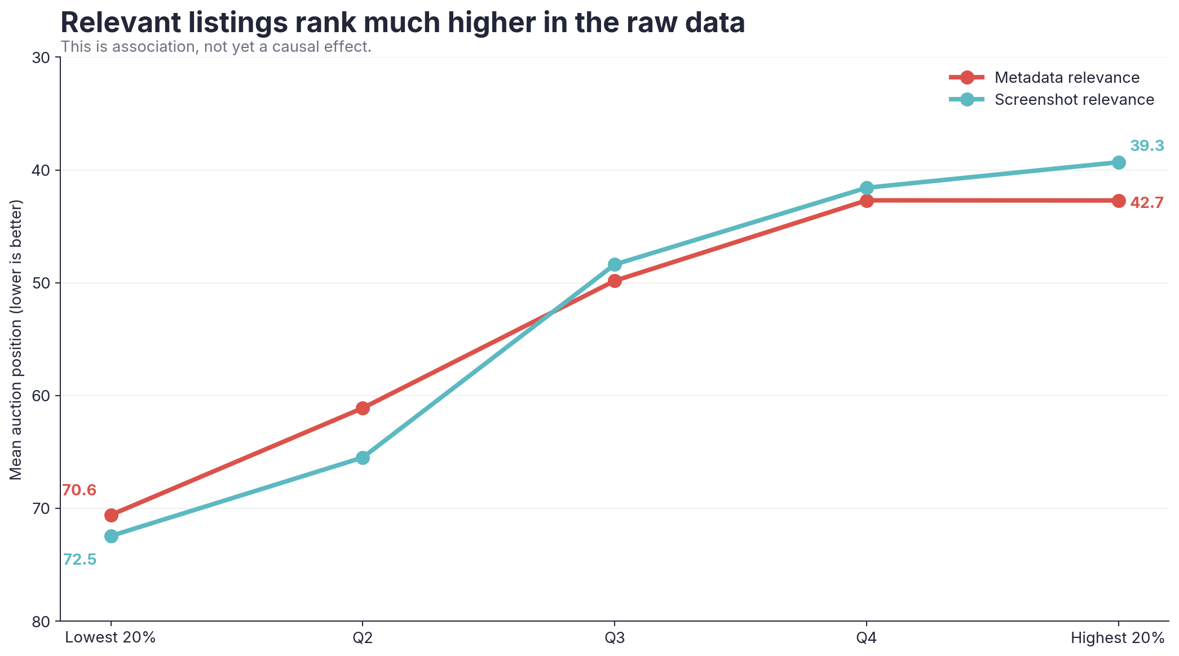
Relevant listings rank much higher before controls. Source: 2,746 app-keyword-page units from the APPlyzer study.
This is the trap.
Raw correlation mixes relevance with bid, brand strength, ratings, campaign priority, advertiser sophistication and historical performance. Good advertisers tend to arrive with good creative and good bids. We therefore need to control for who the app is, which keyword is being auctioned and when the observation occurred.
What remains after controlling for the app, keyword and time?
Metadata remains. In the primary fixed-effect model, a 10-point increase in metadata relevance was associated with a 3.44-position improvement in auction rank. The 95% confidence interval was 2.22 to 4.66 positions better, and the result was statistically strong.
The title did most of the work. A 10-point increase in title relevance was associated with 2.58 positions better auction positiojn. Long-description relevance had a smaller 0.73-position association that did not quite reach conventional significance. Subtitle relevance had no separately reliable effect once the other fields and fixed effects were included.
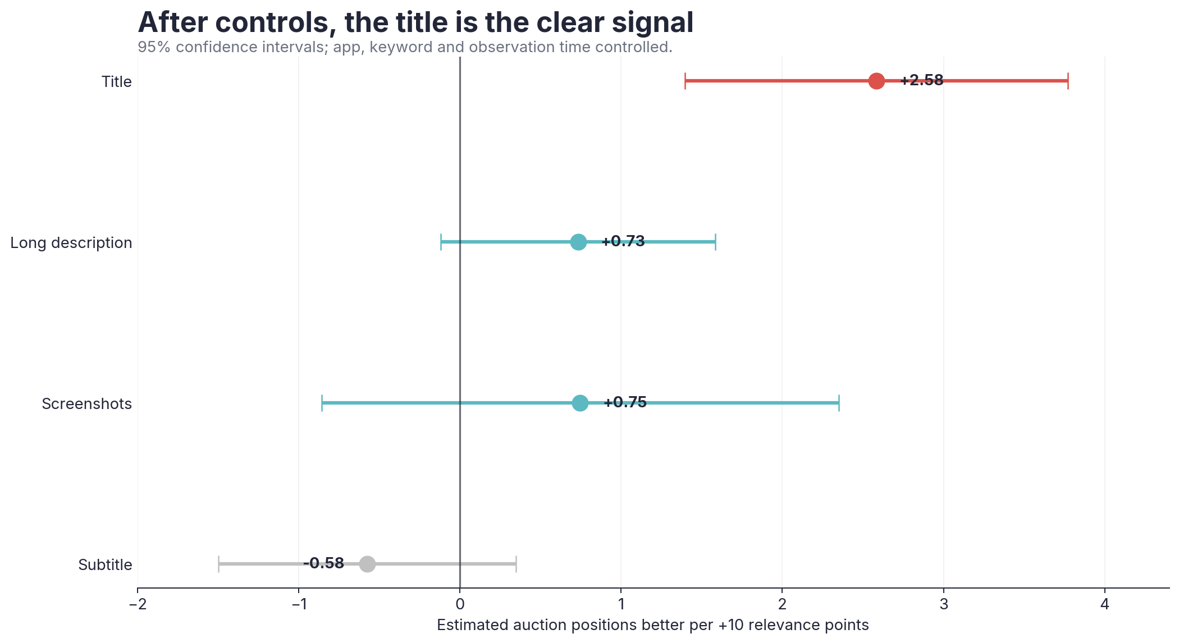
The title is the only field with a clear independently measured relationship. Positive values mean better auction position. Source: APPlyzer fixed-effect component model.
Ratings and rating volume were included as controls, but neither had a separately reliable coefficient once app identity was controlled. That does not mean ratings are commercially irrelevant. They may still affect tap-through and conversion; this model simply could not isolate an additional direct rank relationship.
Plain English.
The title survived the statistical washing machine. The other metadata fields may still help, but this dataset does not support pretending they carry the same auction weight.
Do screenshots influence Apple Search Ads auction rank?
The honest answer is: probably through performance, but we did not prove a large direct ranking effect. Screenshot relevance had the strongest raw correlation with rank, yet its adjusted coefficient shrank to 0.53 positions better per 10 points and was not statistically reliable. In the field-level model, the estimate was 0.75 positions better with a confidence interval that crossed zero.
That is not evidence that screenshots do nothing. They are one of the biggest influences on whether someone taps and installs. The finding is narrower: once we compare the same app across keywords and times, static semantic relevance in the screenshots does not independently explain much of the auction order. The screenshots were, to a large extent, guilty by association.
A beautifully relevant screenshot set can still lose to a less elegant advertiser with a higher effective bid. Equally, a generic but trusted brand with strong ratings and historical response can convert well without literally repeating the keyword in every frame.
Do apps using CPPs rank higher?
Yes, dramatically in the raw data. CPP-active observations averaged position 28.0. Apps that were capable of using a CPP but happened to be running their default page averaged 43.0. Apps never observed using a CPP averaged 54.4. CPP-active rows were almost five times as likely to be in the top 10 as never-CPP rows.
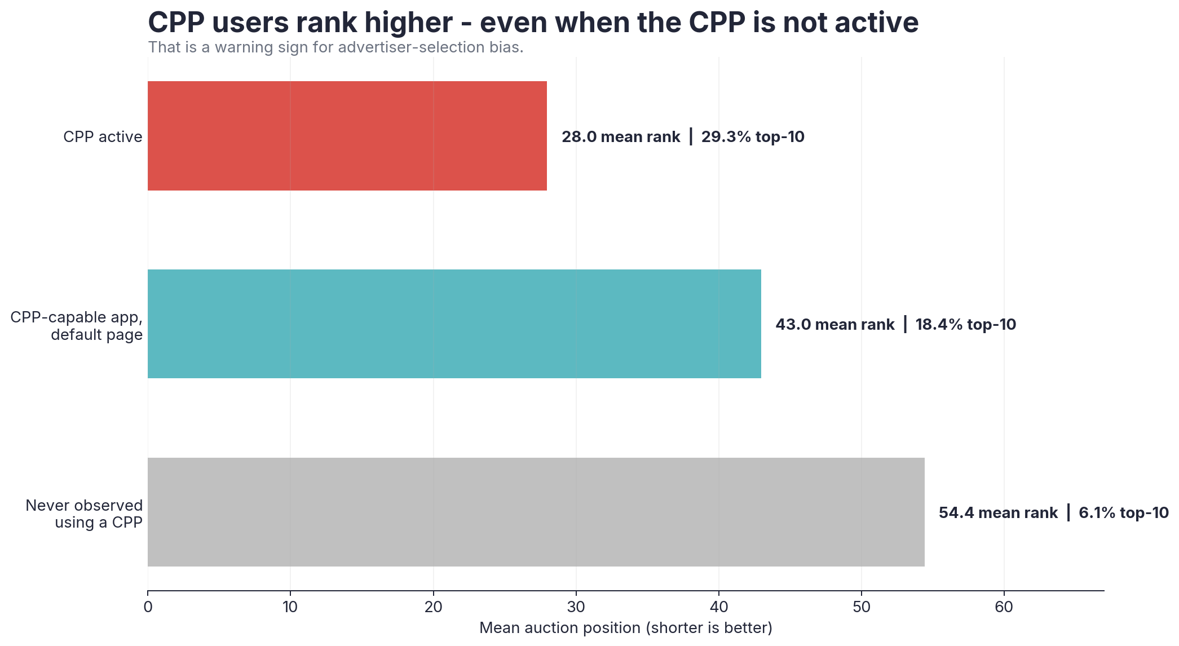
CPP users are a different advertiser population before the creative is even active. Source: 27,817 matched auction observations.
That middle bar is the giveaway. Even when CPP-capable apps used their default page, they ranked roughly 11.5 positions better than apps that never used a CPP. CPP usage is therefore also a marker for larger budgets, stronger campaign structures, more active optimisation and greater keyword priority.
But, is the CPP itself causing the rank improvement?
The closer comparison looked at 139 app-keyword pairs that switched between a default page and a CPP. The CPP observations ranked 1.99 positions better on average, with 63.3% of pairs improving. That is a modest, statistically credible association - but still not proof that Apple rewards the CPP itself.
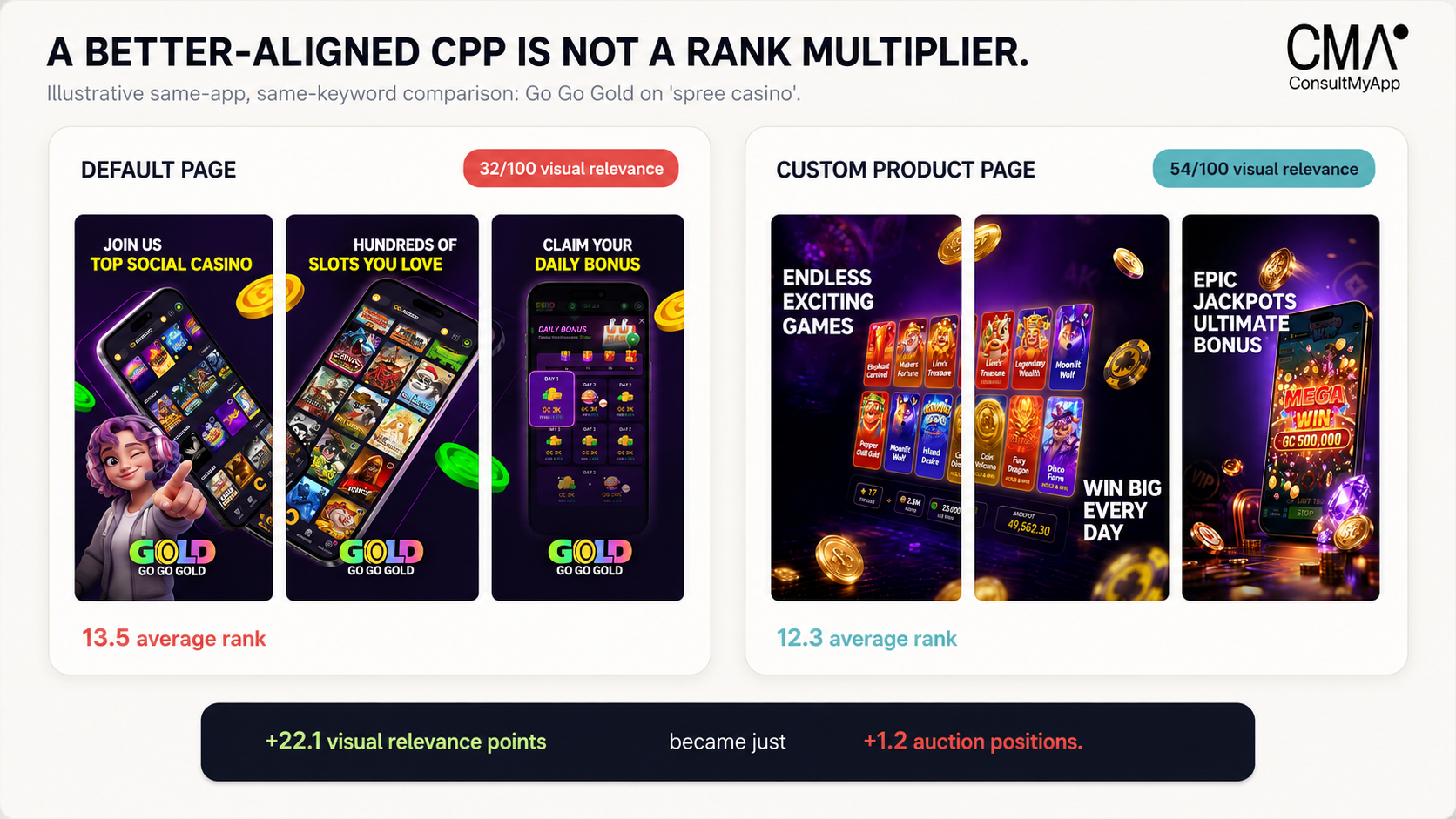
One illustrative example: much more keyword-aligned creative, but only a small rank change
The critical test was whether a larger visual-relevance improvement produced a larger rank improvement. It did not. The Spearman relationship between CPP visual lift and rank lift was -0.044, with a p-value of 0.61: effectively zero.
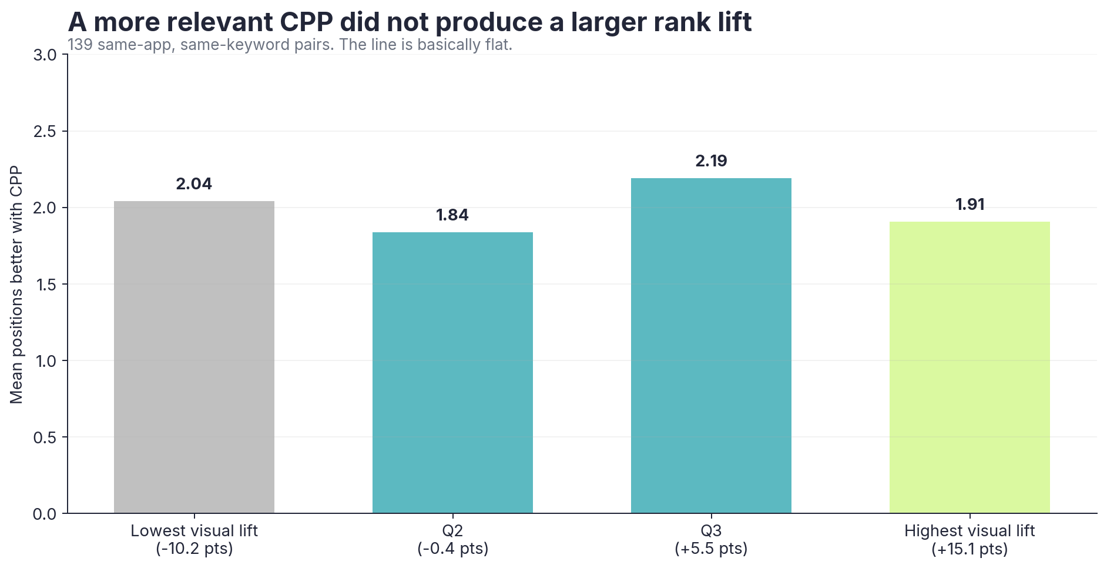
Whether CPP visual relevance fell by about 10 points or rose by about 15, the average rank improvement stayed close to two positions.
Can conversion rate still affect auction position?
Yes. The most defensible route is indirect: better creative improves tap-through or install conversion, which allows a higher bid at the same CPI target. If your target CPI is $10 and tap-to-install conversion rises from 50% to 60%, the maximum affordable CPT rises from about $5 to $6 - a 20% increase. Apple does not need a separate conversion-rate multiplier for the improved campaign to become more competitive.
The route is even clearer with Maximize Conversions. Apple says its automation uses real-time signals to set an optimal bid for each relevant query and prioritises terms most likely to generate installs. In that setup, predicted install performance explicitly influences the effective bid. Read Apple's Maximize Conversions guidance.
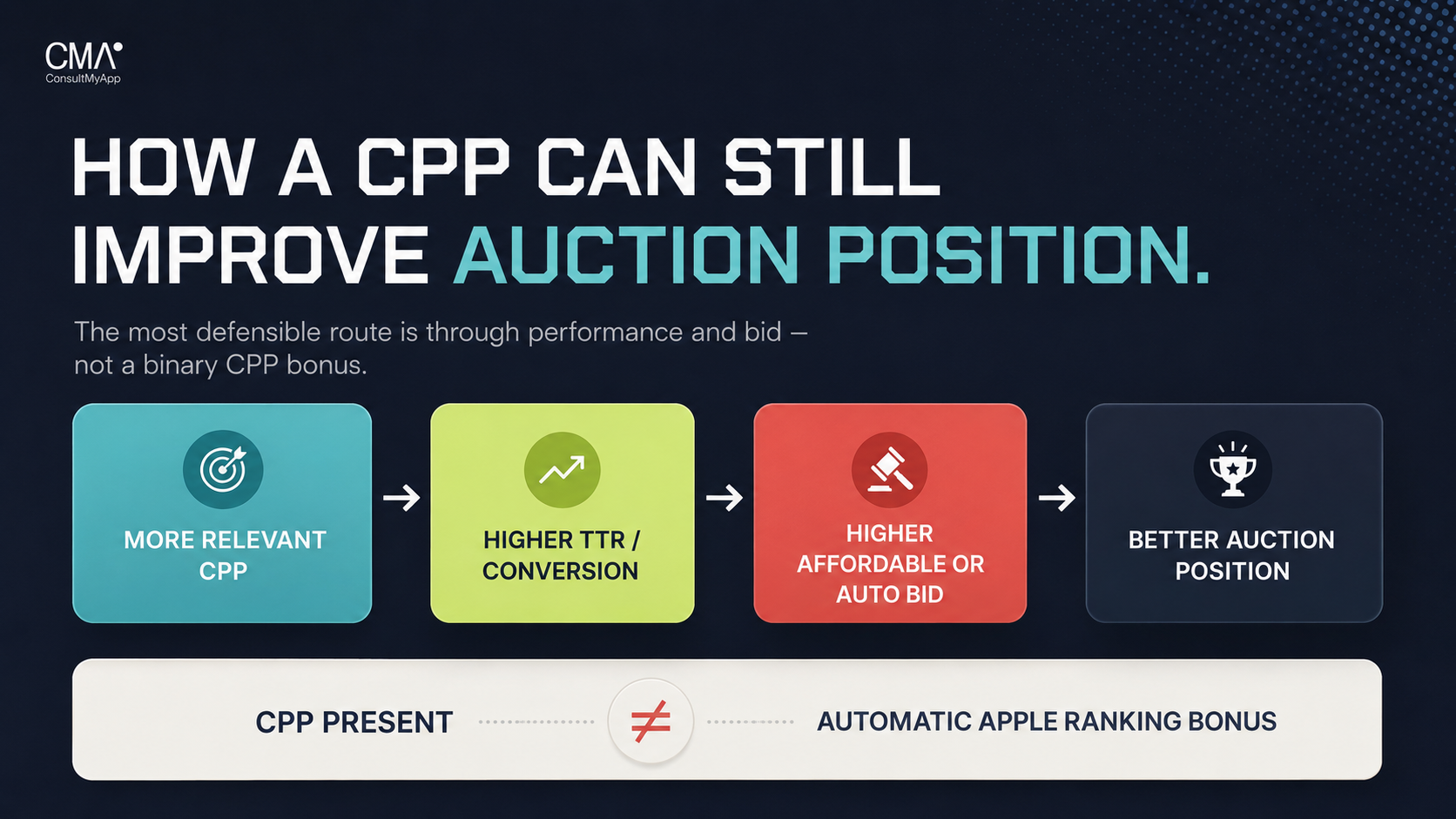
The performance-to-bid pathway is clear and proven. A binary CPP-to-auction rank bonus is not.
What should app marketers change?
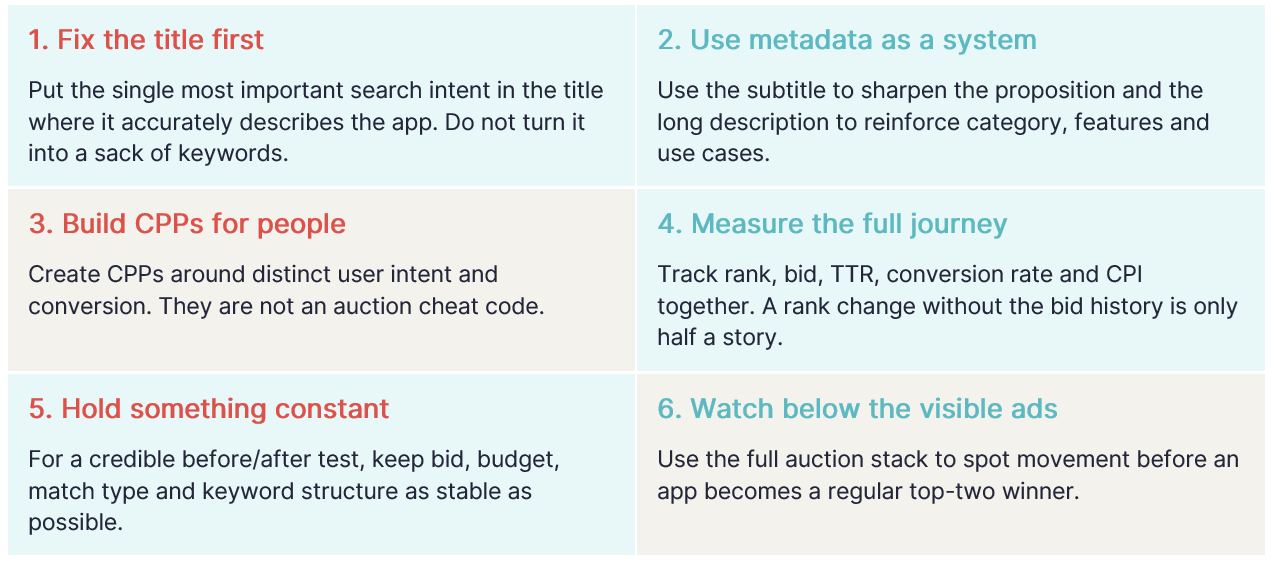
How APPlyzer makes this measurable.
A visible-ad monitor (ie most other data platforms) tells you which app won the top 2 ad slots at that moment. APPlyzer captures the full auction stack from positions 1 to 100, identifies when an advertiser is using a CPP through the page URL, tracks rank movement over time and connects the observed page to metadata and screenshot relevance.
That makes it possible to ask better questions: did rank improve before or after a metadata update? Did a CPP launch coincide with a bid increase? Did a competitor climb from position 30 to position 8 before it became a regular visible winner? A normal screenshot report misses most of that story.
The practical use.
Use relevance scores to diagnose content, full-stack rank to measure competitive movement and campaign data to identify the mechanism. Do not collapse all three into one mysterious "quality score".
Frequently asked questions.
Does metadata affect Apple Search Ads auction position?
Yes. A 10-point increase in APPlyzer's metadata relevance score was associated with a 3.44-position improvement after controlling for app, keyword and time. This is an empirical association, not an official Apple weighting.
Which App Store metadata field matters most for Apple Ads?
The title. A 10-point increase in title relevance was associated with 2.58 positions better, and it was the only individual metadata field with a clearly reliable adjusted coefficient.
Do screenshots affect Apple Search Ads rank?
They have a strong raw relationship with rank, but this study did not find a separately reliable direct effect after controls. Their most defensible impact is through tap-through, conversion and the bid that an advertiser can afford or an automated bidder will set.
Does using a CPP guarantee a better auction position?
No. CPP-active ads ranked higher, and same-app switchers were about two positions better on average, but a larger improvement in CPP visual relevance did not produce a larger rank improvement. Bid and campaign-priority selection remain the leading explanation.
Does conversion rate determine Apple Search Ads auction rank?
Apple publicly discloses relevance and bid as auction factors, not conversion rate as a separate manual-auction multiplier. Conversion can still influence rank through manual bid economics and Apple's automated Maximize Conversions bidder.
Are these Apple's official relevance weights?
No. Apple does not publish title, subtitle, description, screenshot or CPP weights. The scores and coefficients are APPlyzer research diagnostics built from the observed full auction stack.
The bottom line.
Metadata matters. The title matters most. CPPs matter to performance, but not as a magic ranking button. Better creative can improve message match and conversion, which can support a stronger effective bid; simply attaching a CPP does not appear to buy a place at the front of the queue.
The biggest analytical mistake is to launch a CPP, raise the bid and budget at the same time, see rank improve and credit the whole result to creative relevance. Apple Ads is an auction. The inputs travel together unless you make a serious effort to separate them.
APPlyzer gives you the missing layer: the full auction stack, the page variant being used and the movement below the visible ad slots. That turns "we moved up" into a much better question: "what actually moved us up?".
If you’d like to chat to us about how we can significantly improve your ASA campaign performance by leveraging our world-leading expertise and data models, please reach out here!