CMA research | AI app marketing
And make sure it can see the full Apple Ads auction.
“Who are the top five apps bidding on this keyword right now?”
That's a useful question for an AI app marketing tool. APPlyzer can show the apps in auction positions one to five at a given moment, including the competitors sitting below the two visible ad spots.
Those extra names matter. I'd like to know who we're up against before the campaign gets expensive.
Here are five questions we'd ask, using APPlyzer's auction research, data through 9 November and October creative examples. Each finding has its date.
1. Who's in the auction?
Take “casino” on US iPhone at 04:45 UTC on 17 July 2026. APPlyzer captured this top five:
| App | Auction position |
|---|---|
| Cider Casino | 1 |
| CrownCoins Casino | 2 |
| McLuck | 3 |
| Lavish Luck | 4 |
| Gleaming Slots | 5 |
Source: APPlyzer's published auction study. Historical capture, ranked by auction position. [5]
A tool stopping at the two visible ads would leave McLuck, Lavish Luck and Gleaming Slots out of this capture. McLuck didn't stop being a competitor because it was third.
We investigated how much that matters. Our study covered 56,063 auction-position observations across 569 captures and 20 US casino/social-casino search terms. In that study, apps in positions 3–5 reached the top two in the next snapshot 12.9% of the time. Nearly one in eight.
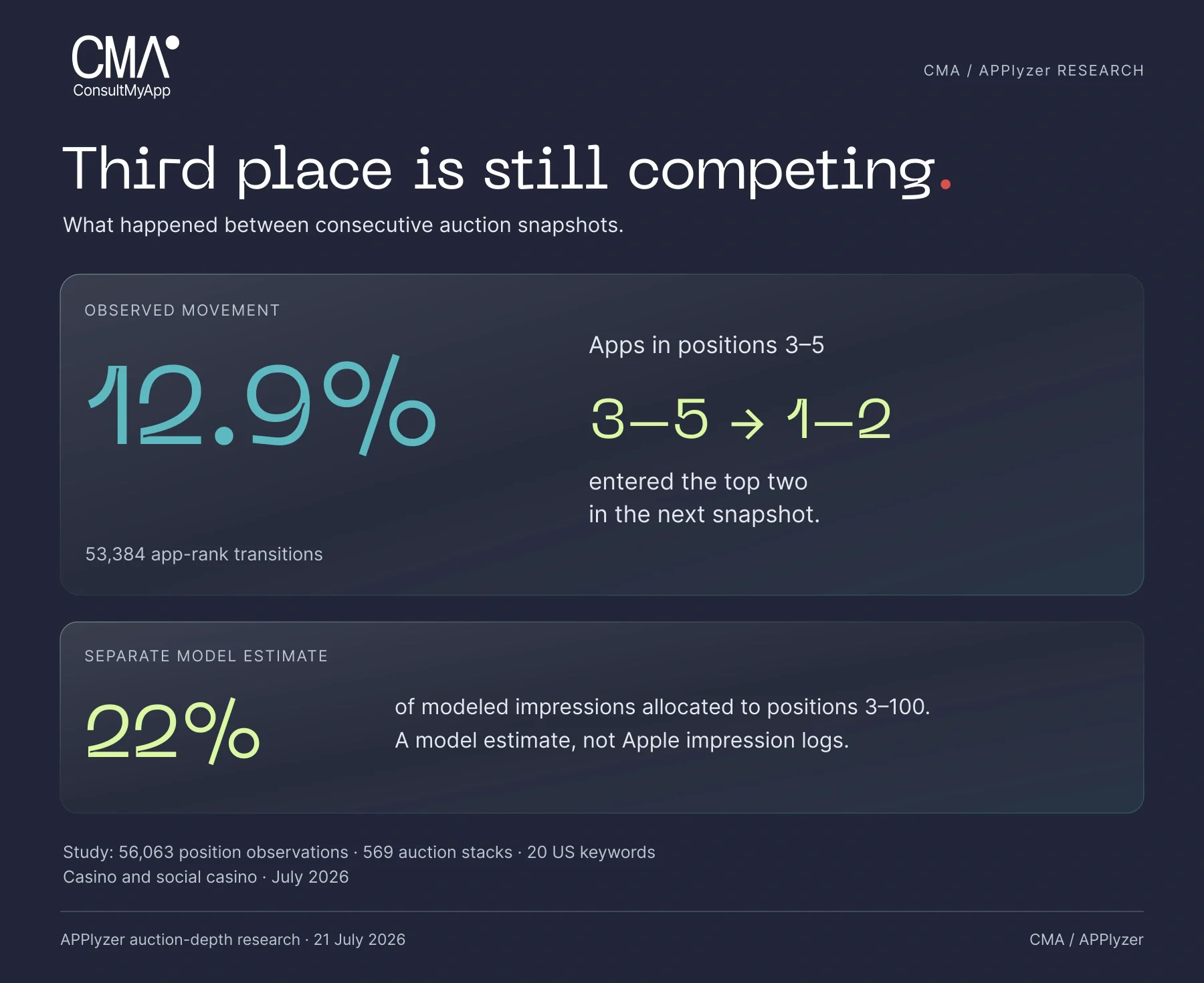
APPlyzer's share-of-voice model also estimates 22% of impressions across positions 3–100. That's a modeled estimate; the movement between auction positions is observed. Both give a marketer good reason to watch the competitors below the front pair. [5]
The five-app answer gets the conversation started. APPlyzer's deeper data reaches 100 positions; the study identified the top 50 as the practical depth for share-of-voice analysis. I'd ask AI which apps are climbing, then inspect their message before they become a regular fixture at the front.
2. Who's on my brand?
On “wise” in the US, 80 APPlyzer captures contained 26 distinct apps across positions 1–5. Keep only positions one and two from those same captures and you're left with six.
Twenty apps disappear from the analysis.
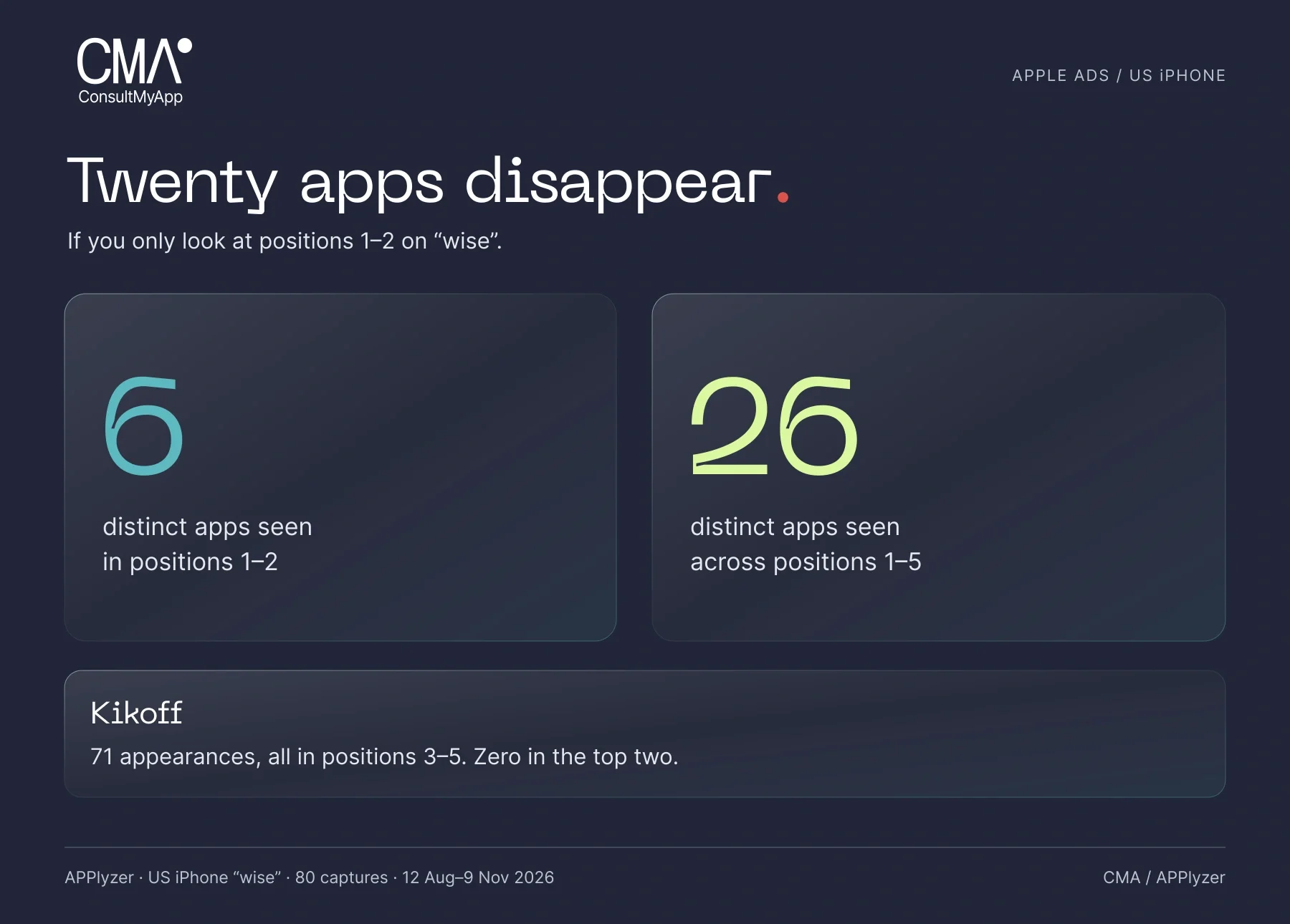
Kikoff appeared 71 times, all in positions 3–5. Revolut appeared 61 times, but reached the top two in only five of those checks. A two-position view would erase Kikoff and make Revolut look like an occasional visitor. [1]
An AI fed that narrower dataset would write a very different competitor brief. I'd want the full list, their product pages, and a comparison of the offers. Then we can decide whether our brand messaging or campaign coverage needs attention.
3. Who did we miss?
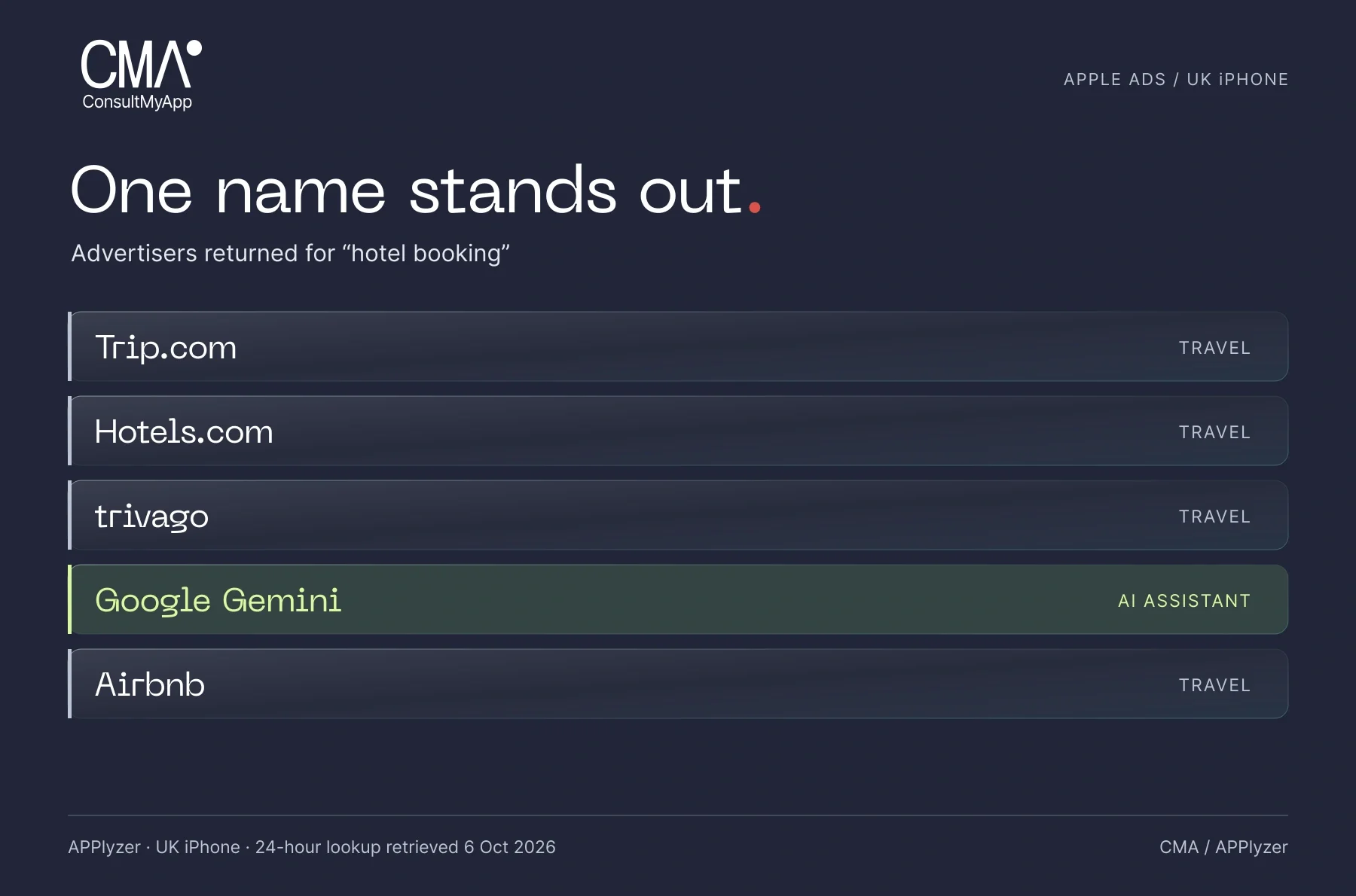
Our October UK iPhone lookup for “hotel booking” returned Trip.com, Hotels.com, trivago, Airbnb and Google Gemini.
Four travel brands and an AI assistant. That would get my attention.
Across the UK and US sample, Gemini appeared against 19 distinct phrases, including “learn Spanish”, “workout app” and “travel planner”. [2]
A competitor list built from the usual booking apps could miss that. I'd check how Gemini's auction position changes and inspect its creative. If it is offering help with planning a trip, our team has a different proposition to think about.
4. What does the page promise?
For “learn Spanish” in the US, APPlyzer's archive linked two very different custom product pages.
Pimsleur opened with an AI conversation coach and an explicit Spanish message. Busuu opened with “Effective language learning”, followed by “Study tools for student life” and a Japanese demonstration. Spanish was there too, in its first-frame language list and third-frame courses. [3]
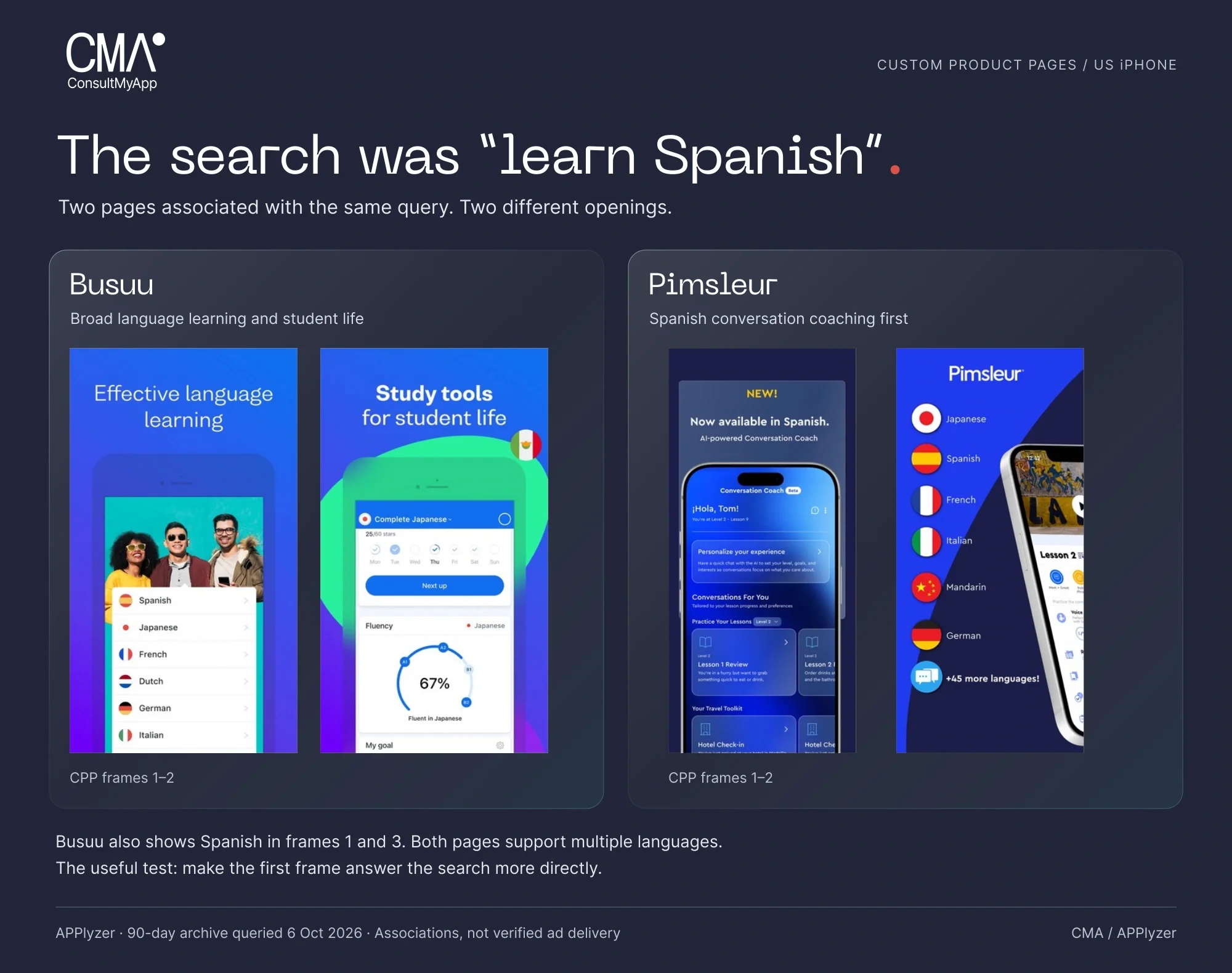
For someone searching for Spanish, I'd test a page that gets straight to Spanish speaking practice. Show a useful conversation and what the learner will be able to do afterwards. Test the student-life message with the audience it describes.
We now have a creative brief with a reason behind it. Conversion results would tell us whether the change worked.
5. Where does paid help?
Amazon appeared in the advertiser results for “shopping apps” in the US. In the same October snapshot, it ranked 12th organically on iPhone and 1st on Google Play. [4]
Even Amazon has to check where it actually turns up.
On iPhone, I'd assess paid coverage alongside the work needed to improve organic ranking. On Google Play, I'd test the additional demand paid activity brings when the app already ranks first. Joining the auction, organic and campaign data gives us a much better basis for that decision.
Try it on your account.
Give your next AI demo a keyword you actually pay for:
Show the top five apps in the latest auction for [keyword] on the [country] iPhone App Store, with their positions and timestamp. Use the deeper auction history to flag new entrants, persistent bidders and the biggest position changes. Compare their product pages with ours, add our organic rank, and suggest one test worth running. Link the evidence.
That's how we use APPlyzer at CMA: give AI the auction detail, then make it useful to the person running the campaign. A polished answer that leaves most of the competition out won't help much with next month's targets.
APPlyzer’s free MCP integration brings its data into compatible AI tools, so you can put these questions to the assistant you already use.
Explore APPlyzer’s free MCP integration
Sources and definitions.
[5] Auction-depth research. APPlyzer: why the top 50 auction positions matter, published 21 July 2026. The study contains 56,063 position observations, 569 auction captures and 53,384 tracked app-rank transitions across 20 US casino/social-casino search terms. The 12.9% figure concerns transitions starting in positions 3–5 and entering positions 1–2 at the next snapshot; median snapshot interval was one hour. The 22% figure is APPlyzer's central impression-share model for positions 3–100, not Apple delivery logs. The casino table reproduces the study's 17 July, 04:45 UTC capture. Auction position is the ranked outcome, not a ranking of bid amounts.
[1] Brand auction depth. APPlyzer US iPhone export dated 9 November 2026, window 11 August–9 November; observed records for “wise” begin 12 August. Across 80 captures: 26 distinct apps in positions 1–5; six ever reached positions 1–2. Counts are derived from slot_1 through slot_5. The comparison keeps the same capture set and changes only the retained positions. These counts describe auction participation, not impression share.
[2] October advertiser research. APPlyzer UK/US iPhone, 24-hour lookbacks collected on 6 October. Hotel-booking lookup retrieved at 19:39 UTC. Gemini appears across 29 keyword-country groups covering 19 distinct phrases. This archive preserves the returned advertiser set; timestamped ranked captures support position comparisons.
[3] Creative. APPlyzer 90-day custom-page archive queried 6 October, US iPhone, paid and organic association scope. Original screenshots from CMA Creative Atlas cases CR16 (Busuu) and CR17 (Pimsleur). Archived page associations do not establish a particular paid impression. Creative recommendations are test hypotheses.
[4] Organic rankings. APPlyzer “shopping apps” US organic results collected 6 October, alongside an iPhone advertiser lookup. Google Play is a separate organic comparison.
APPlyzer is part of ConsultMyApp. Prepared on 11 November using the dated evidence above.