
You Can Demystify the App Store. The Top Publishers Already Have. And the Data Proves It.

For a long time, app marketing has carried an unnecessary air of mystery. Publish, spend, optimise, repeat - and hope the numbers move. Growth has often felt like something that happens to you rather than something you can engineer with confidence.
To be fair, the industry itself is still young. Barely into its second decade. A teenager in commercial terms. Still shaking off the early myths — that success is random, that virality can’t be designed, that only lightning-in-a-bottle ideas truly win. But the charts now tell a much calmer story.
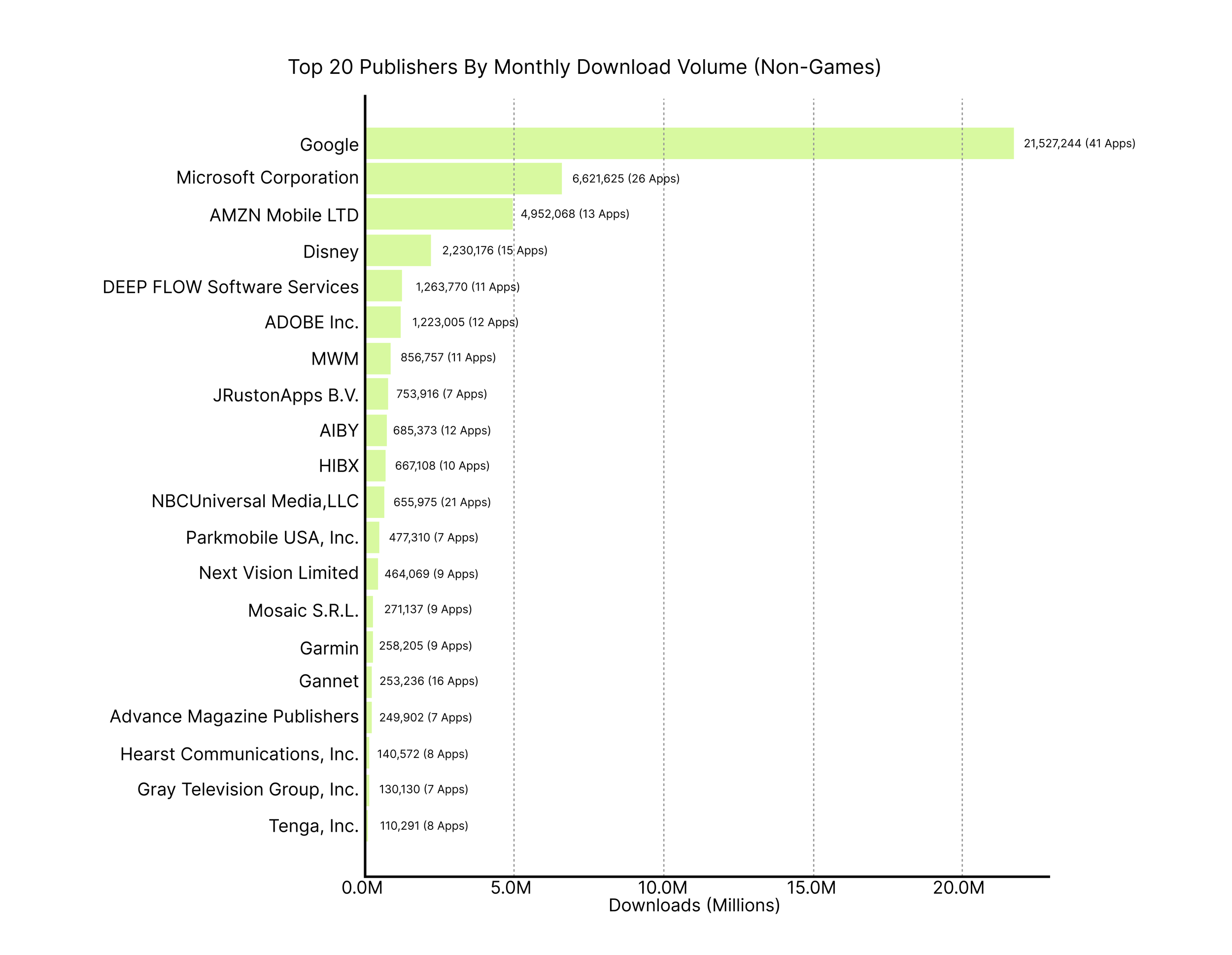
When you look at the publishers who consistently dominate visibility across the App Store — measured by who holds the most apps inside the Top 250 rankings across categories — the same names appear again and again:
Google, Microsoft, Amazon, Disney, Adobe, Netflix, Electronic Arts, Zynga, Voodoo, SayGames, PlaySimple, Crazy Labs.
Different verticals. Different audiences. Different business models. Yet the outcome is the same. They dominate storefront real estate. Not because they are lucky. Not because each app is extraordinary. But because they have quietly turned the App Store from a black box into a distribution system. And once something becomes a system, it becomes repeatable.
What the Data Really Shows About Who Wins
At first glance, these charts look like leaderboards. But they’re not ranking “best apps.” They’re revealing something more commercially important:
Who controls visibility at scale.
Google sits comfortably out in front. Microsoft is firmly established behind it. Amazon, Disney, Adobe and Netflix show deep, stable presence across multiple categories.
Then in games, the specialists — Voodoo, SayGames, Crazy Labs, PlaySimple, Zynga, Electronic Arts — hold disproportionate surface area inside the charts.
But the real signal isn’t just who is visible. It’s how they sustain that visibility.
None of these publishers rely on a single hero product. Google doesn’t dominate because of one flagship app. Microsoft doesn’t either. Amazon and Disney certainly don’t. They dominate because they operate at portfolio level — multiple demand generators, multiple discovery surfaces, multiple entry points into their ecosystems.
In games, the pattern is even sharper. Publishers like Voodoo and Crazy Labs don’t behave like traditional studios waiting years between launches. They behave like production labs. Launch. Test. Cut. Scale. Repeat. This quietly destroys one of the most comforting myths in app growth:
That success is about finding “the one” perfect product. The real winners aren’t betting on perfection. They are betting on systematic visibility and fast validation.
Downloads Are the Secondary Lens — Not the Headline
Once you know who dominates store visibility, the downloads data adds a second, more commercial layer of meaning. It answers a different question:
Which of these publishers are converting their chart presence into sustained demand across their entire portfolios?
This is where the gap between “being seen” and “being chosen” becomes visible. Some publishers occupy enormous shelf space but convert less efficiently at aggregate level. Others turn that same visibility into deep, consistent momentum across many titles at once.
That distinction matters.
Visibility earns you the right to compete. Conversion and engagement decide who actually captures revenue and retention.
If Visibility Is Repeatable, Growth Is Learnable
Taken the wrong way, these charts can feel intimidating. How do you compete with Google? With Microsoft? With Netflix? With publishers launching dozens of apps at once? But that’s the wrong question. The right question is this:
What system allows the same publishers to repeatedly place apps into the most valuable real estate on the App Store?
Because their advantage isn’t scale alone. It’s process. They don’t guess where demand lives. They don’t hope for discovery. They engineer entry points into attention. Which means the path isn’t locked. It’s learnable.
At ConsultMyApp, that belief underpins everything we do. We don’t chase magic. We reverse-engineer how distribution, conversion, and engagement actually work together — and then turn those mechanics into repeatable growth systems. Because sustainable growth doesn’t start with paid spend. It starts with demand engineering.
Creating Demand in a World of Interchangeable Products
Multiple brands. Near-identical products. Soft drinks. Airlines. Streaming platforms. Productivity tools. Strip away the logos and most markets collapse into sameness. Apps are no different. Open ten apps in the same category and you’ll often see the same core features, the same promises, the same value propositions repackaged in different colour palettes and taglines. To a user, the choice feels interchangeable. And yet, someone still wins the download. The answer isn’t “stand out” as a vague ambition. It’s standing out in three very specific, very controllable phases:
Visibility. Conversion. Then scale. Always in that order.
Visibility: If People Can’t Find You, You Don’t Exist
The App Store remains the highest-intent environment in mobile. Users don’t arrive casually. They arrive ready to choose. Visibility, therefore, isn’t branding. It’s availability at the moment of intent. This is where ASO becomes foundational. Understanding what people actually search for. Owning the generic category terms that define your space. Appearing where demand already exists instead of trying to manufacture it somewhere else.
It also means benefiting from the awareness your competitors have already paid for. When users search for established brand names and you appear alongside them, you’re intercepting decision-ready traffic. Long-tail search behaviour still matters too. Smaller keywords rarely make headlines, but compounded properly, they create meaningful incremental growth. At this stage, your creative isn’t selling the product yet. Its job is simpler — and more brutal.
Win the scroll. Create contrast fast. Stop the thumb. Without visibility, nothing else in the growth engine ever gets a chance.
Conversion: Winning the Tap Is a Psychological Game
Being seen is not the same as being chosen. Once a user lands on your store page, the real competition begins. Rows of alternatives. Similar promises. Similar layouts. The difference between a tap and a bounce is rarely technical.
It’s emotional.
It’s visual.
It’s psychological.
Icons, screenshot pacing, visual hierarchy, colour contrast, preview video storytelling — these don’t decorate conversion. They drive it. Small creative changes often outperform major product updates in testing. Messaging carries equal weight. What you lead with becomes why the user believes they should choose you. Speed, simplicity, trust, power, community, exclusivity — each appeals to a different buying psychology.
Then there is trust.
Ratings and reviews are not “nice to have.” They are risk-reduction mechanisms. A 4.7★ app feels safe. A 3.9★ app silently repels. Smart publishers don’t beg for reviews; they engineer the moment when users are happiest and ask then. Conversion isn’t about traffic. It’s about leverage.
Scaling Paid Without Losing Control
Only once visibility and conversion are proven does scale become safe. Too many teams reverse the sequence. They scale first and investigate leakage later. That’s how budgets disappear quickly and confidence erodes slowly.
Smart scaling is incremental. Budgets rise in steps. Channels are layered. Audiences are expanded carefully to avoid early saturation. Creative supply becomes a system. What works at low spend will fatigue at higher volume. Scaling requires variation, channel-specific narratives, and an always-on testing pipeline.
The discipline here isn’t about caution.
It’s about control.
Where CMA Fits
By the time most brands reach us, they don’t need motivation. They need structure. CMA operationalises the same sequence the market leaders already use: demand creation through ASO and acquisition insight, commercial conversion through creative and psychological testing, and controlled scale through disciplined paid growth. We don’t treat these as separate projects. We design them as one connected system. Because that’s how real growth behaves.
Why Engagement Quietly Powers the Entire Flywheel
Most teams think of engagement as retention.
It’s more powerful than that. Engagement feeds acquisition back into itself. Highly engaged users leave better reviews. Reviews lift conversion. Conversion improves rankings. Rankings increase organic visibility. Organic visibility lowers paid acquisition costs.
That is the flywheel. The wrong onboarding delays value. The wrong notification strategy damages ratings. The wrong feature discovery creates friction where momentum should live.
But when engagement is designed properly, users quietly become your most efficient acquisition channel - without ever being labelled as such.
The Real Truth About App Growth in 2025
The App Store no longer rewards mystery.
It rewards method.
The publishers dominating the charts didn’t stumble into momentum. They built systems that connect visibility, conversion, scale, and engagement into one commercial engine.
That’s the good news.
Because once something is a system, it can be learned.
Once it can be learned, it can be repeated.
Once it can be repeated, it becomes a competitive advantage - not a gamble.
Your app doesn’t need luck.
It needs structure.
And structure is exactly what modern app marketing - finally grown out of its teenage years - now knows how to deliver.